
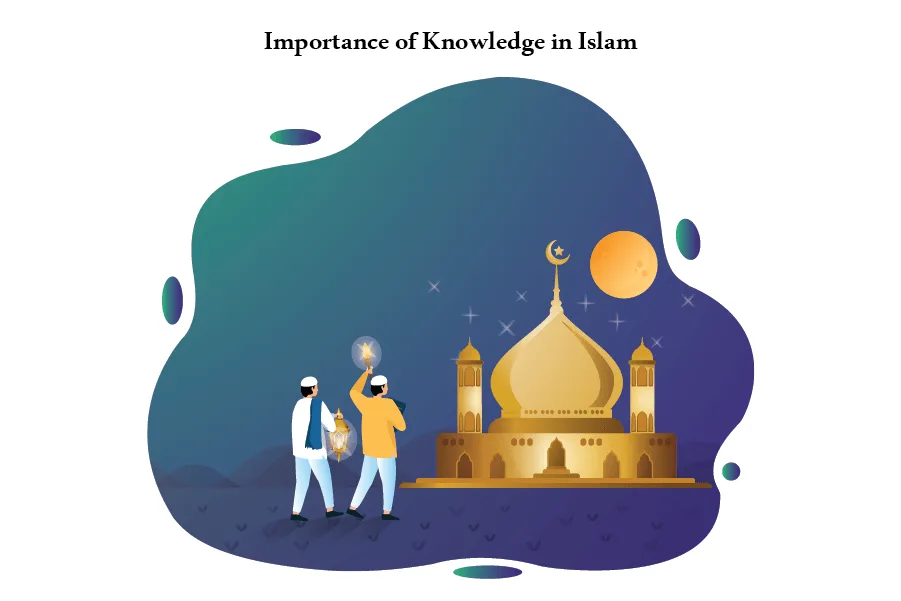
Islam is known as a religion of knowledge and education. The importance of knowledge in Islam can be judged by the fact that education is a religious obligation for every Muslim. The beauty of Islam has obliged the necessity of acquiring education for its followers.
Under this ruling, Muslims can enjoy both; the pleasures of being knowledgeable and the reward in the hereafter for fulfilling the obligation. Seeking and learning are better than any treasure in the world because it helps one face difficulties and solves life's puzzles. With many benefits in this world, acquiring education also has uses in the hereafter.
Importance of Knowledge in Islam
Islam is a religion that celebrates seeking ilm as a virtue. We may find many verses in the Quran encouraging us to exercise our intellect to think and ponder. One such is the verse:
وَسَخَّرَ لَكُم مَّا فِي السَّمَاوَاتِ وَمَا فِي الْأَرْضِ جَمِيعًا مِّنْهُ ۚ إِنَّ فِي ذَٰلِكَ لَآيَاتٍ لِّقَوْمٍ يَتَفَكَّرُونَ
"And He has subjected to you whatever is in the heavens and whatever is on the earth - all from Him. Indeed in that are signs for people who give thought."
(Surah Al-Jathiyah, 45:13)
The following evidence will highlight the importance of ilm in Islam:
The Prophet (S.A.W.) says:
"Every Muslim must acquire knowledge. Allah likes those who seek knowledge".
(Usul Kafi, p.15)
The Prophet (S.A.W.) says:
"Learned discussions enliven the dead hearts provided they lead to Allah and His commands."
(Usul Kafi, p.20)
Concept of Knowledge in Islam:
Seeking and learning are essential to enter Jannah.
The Prophet (S.A.W.) says:
"Allah opens the path of Paradise to one who takes a step on the path of acquisition of knowledge."
(Muniatul Murid, p.11)
The Prophet (S.A.W.) says:
"Acquire knowledge even if it is in China."
(Biharul Anwar, vol. 1, p.57)
Imam Ja’far Sadiq, (A.S.), says:
"Knowledge and action are associated with each other because whoever possesses knowledge acts upon it, and the knowledge and wisdom of the one who puts them into practice remain unimpaired. Knowledge is a Divine voice that invites its bearer to act upon it. If he accepts its invitation and acts, his knowledge lasts, but if he does not respond positively, it forsakes him".
(Usul Kafi, p.22)
It is also noted that:
"A scholar is like a person who always observes fast and offers prayers, and he is like a mujahid who sacrifices his life for Allah's cause. When a scholar dies, a breach occurs in Islam which cannot be filled till the Day of Judgement".
(Biharul Anwar, vol.1, p.82)
According to Imam Ja'far Sadiq (A.S.):
"On the Day of Judgement, Allah will be pleased with a person who honors and respects a Muslim scholar; and He will be annoyed with one who insults a Muslim scholar."
(Biharul Anwar, vol.1, p.82)
Hazrat Ali Ibne Abi Talib (A.S)said:
"What you get through wealth disappears as soon as wealth disappears, but what you achieve through knowledge will remain even after you."
Benefits of Seeking Knowledge in Islam
-
The Path to Paradise
مَنْ سَلَكَ طَرِيقًا يَطْلُبُ فِيهِ عِلْمًا سَلَكَ اللَّهُ بِهِ طَرِيقًا مِنْ طُرُقِ الْجَنَّةِ وَإِنَّ الْمَلاَئِكَةَ لَتَضَعُ أَجْنِحَتَهَا رِضًا لِطَالِبِ الْعِلْمِ
"Whoever takes a path in search of knowledge, Allah will cause him to walk in one of the paths to Paradise. Indeed the angels will lower their wings in great pleasure with the one who seeks knowledge."
(Sunan Abi Dawud)
-
Ranks being Raised
يَرْفَعِ اللَّهُ الَّذِينَ آمَنُوا مِنكُمْ وَالَّذِينَ أُوتُوا الْعِلْمَ دَرَجَاتٍ ۚ وَاللَّهُ بِمَا تَعْمَلُونَ خَبِيرٌ
"Allah will raise those who believe among you and those who were given knowledge by many degrees. And Allah is All-Aware of what you do."
(Surah Al-Mujadila, 58:11)
-
Allah intends goodness
مَنْ يُرِدِ اللَّهُ بِهِ خَيْرًا يُفَقِّهْهُ فِي الدِّينِ
"If Allah intends goodness for a person, He gives him the understanding of the religion."
(Sahih Bukhari)
-
Open the doors of virtues
إِنَّمَا يَخْشَى اللَّهَ مِنْ عِبَادِهِ الْعُلَمَاءُ ۗ إِنَّ اللَّهَ عَزِيزٌ غَفُورٌ
"It is those of His servants who have knowledge who stand in true awe of Allah. Indeed Allah is almighty, most forgiving"
(Surah Fatir, 35:28)
Conclusion:
In Islam, the pursuit of Ilm holds a position of unparalleled importance, deeply ingrained in the faith's core teachings and practices. It is not merely an encouraged endeavor but a divine obligation upon every Muslim, transcending gender, age, and social status. The Qur'an and Hadith extensively emphasize the virtues of seeking ilm, portraying it as a path leading to spiritual enlightenment, moral refinement, and societal betterment.
Ilm in Islam is holistic, encompassing both religious understanding and worldly sciences, reflecting the belief that all knowledge originates from Allah. This comprehensive approach empowers individuals to discern truth from falsehood, fosters intellectual growth, and encourages innovation and progress within the framework of Islamic ethics.
Historically, this profound appreciation for knowledge propelled Islamic civilization to remarkable heights in various fields such as medicine, mathematics, astronomy, and philosophy. Ultimately, the relentless quest for Ilm is seen as a means to achieve closeness to Allah, fulfill one's purpose, and contribute positively to humanity, embodying the true spirit of Islam.
FAQs on the Importance of Ilm in Islam
1. Why is seeking Ilm considered obligatory for every Muslim?
Seeking Ilm is obligatory because it enables Muslims to understand their faith correctly, perform their religious duties appropriately, and live according to Islamic principles. It is commanded by Allah and emphasized by Prophet Muhammad (PBUH) to ensure that believers lead righteous lives and contribute positively to society.2. Does Ilm refer only to religious knowledge in Islam?
No, Ilm in Islam encompasses both religious ilm and worldly sciences. While understanding the Qur'an and Sunnah is paramount, Islam encourages the pursuit of all beneficial ilm, including fields like medicine, engineering, and social sciences, as long as they contribute to the well-being of humanity and are in line with Islamic ethics.3. How does seeking Ilm bring one closer to Allah?
By seeking Ilm, a person gains deeper insight into the signs of Allah in the universe, strengthens their faith, and enhances their ability to worship Him sincerely. Knowledge enables believers to appreciate the wisdom behind Allah's creations and commandments, fostering a stronger, more personal connection with the Creator.4. What did Prophet Muhammad (PBUH) say about the importance of Ilm?
Prophet Muhammad (PBUH) said, "Seeking knowledge is an obligation upon every Muslim" (Ibn Majah). He also stated, "Whoever follows a path in pursuit of knowledge, Allah will make easy for him a path to Paradise" (Muslim). These sayings highlight that the pursuit of Ilm is highly valued and rewarded in Islam.5. How has the emphasis on Ilm impacted Islamic civilization historically?
The emphasis on Ilm led to a golden age in Islamic civilization, where scholars made significant advancements in various disciplines such as mathematics, medicine, astronomy, and philosophy. This pursuit of ilm not only enriched Islamic societies but also had a profound influence on the global intellectual heritage, laying foundations for modern sciences.