
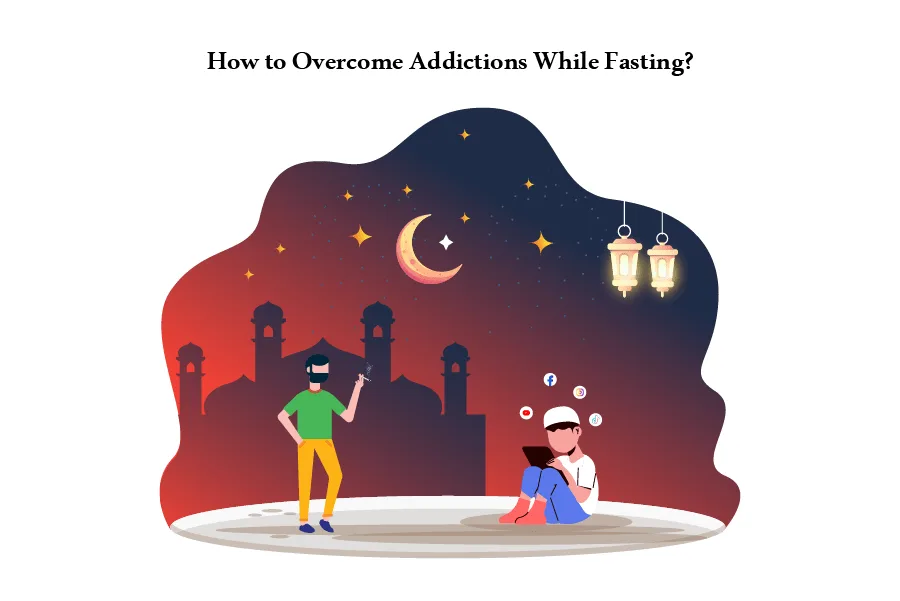
Ramadan offers a unique opportunity for those struggling with addictions to engage in deep self-reflection, identifying habits and distractions that pull them away from the worship of Allah (SWT). This blessed month encourages a period of spiritual detox, where one can temporarily abstain from addictive substances and behaviors that weaken spiritual connection.
While quitting cold turkey during Ramadan may feel like a shock to the system, it also emphasizes one’s capacity for resilience and self-control. This month becomes a time to recognize that, if one can withstand these urges for the sake of fasting and worship, then they indeed possess the strength to continue on this path of recovery beyond Ramadan. This reflection can empower a lasting commitment to healing, bringing hope and the realization that with Allah’s help, true change is possible outside of Ramadan.
What Are The Ways To Overcome Addictions While Fasting?
Addiction, as defined by Webster’s Dictionary, refers to an abnormal tolerance or dependence on something that becomes habit-forming, either psychologically or physically. People can develop addictions to a range of substances, activities, or behaviors that, over time, become difficult to control. While alcohol and drugs are among the most commonly recognized addictive substances, milder substances such as coffee, tea, sugar, and sodas can also lead to dependence.
Even food can become an addiction when used for comfort or as a coping mechanism. Beyond substances, certain activities also have addictive potential; watching TV and spending time on social media, for example, can consume hours of one's day and gradually turn into habits that interfere with daily life and responsibilities. This wide range of potential addictions reflects the complexity of dependency and highlights the importance of mindful moderation in all areas.
This article will cover a few tips that may help a person overcome their addictions while fasting. We will use the running example of abstaining from smoking while fasting during Ramadan.
Think Smart To Avoid Addictions:
Smart is an acronym for goal setting. A SMART goal is Specific, Measurable, Attainable, Relevant, and Timely.
Your goal should be clear, not general. Ask yourself what you want to achieve. Here is a list of questions you can ask yourself when setting your goals, as well as a running example of what an answer may look like:
-
What exactly do I want to achieve?
I want to quit smoking.
-
How?
Since I am fasting and unable to eat or drink, I will replace my smoking behavior with a healthier alternative (such as worship, exercise, reading, etc.). This healthier alternative should also be specific. For this example, we will use reading Quran as the alternate action).
-
When?
For the entire month of Ramadan.
-
With whom?
Social supports are a great indicator of sticking to your goals. If you have friends who smoke and want to quit, you can encourage each other.
-
What are the conditions and limitations?
Know what your triggers are and how to manage your cravings. For instance, I tend to smoke when I am stressed. To quit successfully, I know I have to control stress. I will take a walk every day after work rather than smoke.
-
Why exactly do I want to reach this goal?
What is your internal motivation? Ramadan provides an external stimulus, but individuals are more successful at breaking and keeping an intrinsically motivated habit. In the running example, intrinsic motivation to quit smoking could be to become a better Muslim/healthy for your family, etc.
Tips to Overcome Addiction
-
Measurable
The means to break your goal into quantifiable elements can identify precisely how you expect to feel as you are taking steps to achieve your goal. It could include making a calendar and stickers to mark the days you have gone without smoking.
-
Attainable
To investigate whether your goal is acceptable to you, you weigh the pros and cons, the effort, and the time it will take to complete your objective and evaluate whether it is something you genuinely want to accomplish. It doesn’t mean you cannot take the impossible and make it happen. It merely means you will need to make it happen through careful planning.
-
Relevant
Is reaching your goal important to you? In what way? Where do you see yourself in the future if you continue your habit versus if you discontinue the practice? Knowing this about yourself will provide you with some motivation to reach your goal.
-
Timely
It involves having a specific time frame to complete your goal (which is easy to do in the month of Ramadan). It takes a month to make or break a habit, so use this time wisely to overcome your addictions while fasting.
Final words
Relapse is a common part of the recovery journey from addictions, and experiencing it does not signify the end of your progress. Instead of viewing relapse as a failure, consider it a stepping stone, an opportunity to reassess your strategies and refine your goals in overcoming addiction.
Every relapse brings valuable lessons, highlighting areas in your life that might require more attention, support, or a fresh approach. This perspective transforms setbacks into opportunities for growth, helping you better understand the triggers and challenges associated with your addictions. Use these moments to deepen your resolve, ensuring that each step forward is built on a foundation of renewed strength and clarity.
The journey to overcome addictions is undoubtedly challenging, but it is also deeply transformative. As you face the highs and lows, remain steadfast in your faith and hopeful about the progress you are making. Each effort you invest in breaking free from addiction brings you closer to the life you aspire to lead.
Remember, it’s not just about resisting temptations but also about building habits that nurture your mental, emotional, and spiritual well-being. Reflecting on these efforts, especially during moments of fasting and spiritual connection, can provide immense motivation. Seeking closeness to Allah (SWT) through these trials fosters resilience, making every step toward recovery more meaningful.
Recovery from addictions is a gradual process that requires patience, self-compassion, and unwavering motivation. The road may feel overwhelming at times, but even the smallest actions, when repeated with consistency, create a powerful impact.
Turn to Allah (SWT) in moments of weakness, asking for strength to persevere through the difficulties. His mercy is boundless, and He understands the struggles of His creation. Each prayer and act of repentance strengthens your connection to Him, renewing your spirit and guiding you through the darkness of addiction toward the light of freedom and inner peace.
May Allah (SWT) grant all of us the strength, wisdom, and determination to overcome our addictions and emerge stronger from the struggles we face. Especially as we fast and focus on spiritual growth, may He ease this journey, offering guidance and solace at every step.
This path, though difficult, is one of immense reward, as it brings us closer to lasting change and tranquility. Let us continue striving, confident in the knowledge that Allah (SWT) blesses every sincere effort we make. Ameen