
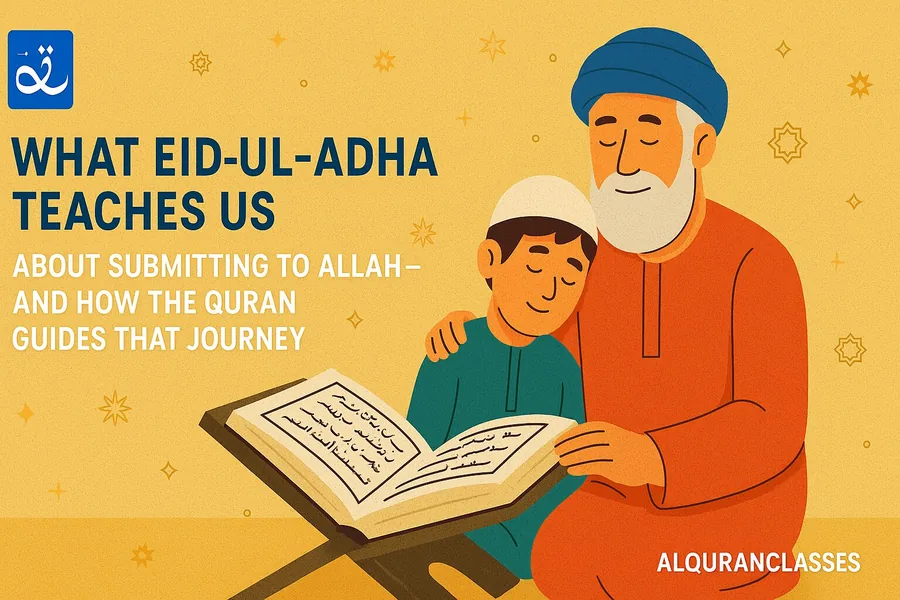
Every year, as Muslims across the globe prepare for Eid ul-Adha, we remember the legacy of Prophet Ibrahim (AS)—a man who embodied unwavering submission to Allah’s will. His willingness to sacrifice his beloved son Ismail (AS) stands as one of the most profound examples of obedience in the history of faith.
But how do we, as everyday Muslims—especially adults trying to reconnect with Islam—live out that kind of submission? And what does the Quran teach us about walking that path?
In this blog, we explore what Eid ul-Adha teaches us about submission to Allah, and how learning the Quran as an adult can bring us closer to that level of sincerity and trust.
🕋 The Essence of Eid ul-Adha: Submission Without Hesitation
At its heart, Eid ul-Adha is not about sacrifice—it’s about submission. The story of Ibrahim (AS) and Ismail (AS) is not just a historical account; it’s a spiritual roadmap.
Allah says in the Quran:
“When he (Ibrahim) said to his son, ‘O my son, indeed I have seen in a dream that I must sacrifice you,’ he said, ‘O my father, do as you are commanded. You will find me, if Allah wills, of the steadfast.’”
— [Surah As-Saffat, 37:102]
Here we see two extraordinary things:
- Ibrahim (AS) does not question Allah’s command.
- Ismail (AS) submits with full trust, despite being the one to be sacrificed.
What Eid ul-Adha teaches us is that true faith means surrendering our desires, our logic, and even our comforts—because we trust that Allah knows best.
📖 How the Quran Shapes a Heart of Submission
So how do we build this level of submission in our own lives?
The answer lies in the Quran.
The Quran is not just a book of guidance—it’s a training manual for the soul. It is filled with stories, lessons, and reminders that gradually reshape the way we think, feel, and respond to Allah’s commands.
“Indeed, this Qur’an guides to that which is most upright.”
— [Surah Al-Isra, 17:9]
When you engage with the Quran—especially as an adult—you begin to internalize the very mindset that made Ibrahim (AS) such a powerful example. You start to:
- Recognize Allah’s wisdom in every decision
- Let go of control and practice trust
- Welcome difficulty as a test, not a punishment
And this is precisely what Eid ul-Adha teaches us: Obedience isn’t always easy—but it’s always worth it.
👨👩👧 A Message to Parents and Adult Learners: It’s Not Too Late
Many adults, especially those living in North America, feel a sense of regret during Islamic holidays. They wish they had memorized more Quran. They wish they could teach their children. They wonder if it’s too late.
But Eid ul-Adha teaches us that Allah loves sincerity more than perfection. Ibrahim (AS) was tested later in life. His trials came after years of learning and building faith. Likewise, your Quran journey can begin right now, no matter your age.
Starting to learn the Quran as an adult is not a sign of delay—it’s a sign of awakening. It is your way of saying: “O Allah, I hear and I obey.”
🧠 How Learning the Quran Builds the Spiritual Muscle of Submission
Submission to Allah doesn’t come overnight. It is something we develop—gradually, intentionally, and with the right tools. And there is no tool more powerful than the Quran itself.
When we think about the legacy of Prophet Ibrahim (AS) and what Eid ul-Adha represents, we are reminded of a man who didn’t just submit once—but over and over again throughout his life. His ability to say "Yes, O Allah" in moments of immense emotional and spiritual difficulty came from a heart that had been trained in obedience.
The question is: How can we train our own hearts to respond like that?
The answer lies in learning and engaging with the Quran regularly—especially as adults. Here's how the Quran builds the very muscle of submission in our spiritual lives:
1. It Strengthens Spiritual Discipline
Learning the Quran requires consistency. Whether you're memorizing verses, learning Tajweed, or reflecting on the meanings through tafsir, it all takes daily effort. And this effort is what slowly builds discipline.
Prophet Ibrahim (AS) was able to submit to the unimaginable command of sacrificing his son because he had already spent years practicing spiritual discipline—trusting, obeying, and waiting. That kind of obedience is forged through repetition, not inspiration.
Likewise, when we set aside time each day—even just 15 minutes—to sit with the Quran, we train ourselves to prioritize Allah over our worldly distractions. Every time you choose to open the Mushaf instead of scrolling your phone, you're building your spiritual muscle.
It’s not about perfection. It’s about returning, again and again, to the Quran. That rhythm becomes your inner strength—so that when a test comes, your heart has already been trained to say “Sami’na wa ata’na”—“We hear and we obey.”
2. It Builds Trust in Divine Wisdom
The Quran is filled with stories of people who were tested—Prophets, believers, and even entire nations. And in almost every story, there’s a pattern: things don’t make sense in the moment, but clarity comes later.
When you regularly engage with these stories, you begin to absorb the deeper lesson: trust Allah even when you can’t see the whole picture.
Ibrahim (AS) didn’t know that Allah would replace his son with a ram. He only knew that Allah commanded him—and that was enough. That’s the level of tawakkul (trust) we are all working toward.
When you read the Quran consistently, you begin to see your own life through that lens. The difficult moments become tests, not punishments. Delays become divine wisdom, not rejection. The more you immerse yourself in the Quran, the more your heart learns to rest in Allah’s knowledge—even when yours falls short.
That is what Eid ul-Adha teaches us: submit first, understand later.
3. It Softens the Heart
In a world that hardens us daily—with stress, deadlines, disappointments, and distractions—the Quran acts as a healing balm. But it only works if we open ourselves to it regularly.
The words of Allah are described as Shifaa—a healing. When you engage with the Quran consistently, something beautiful begins to happen: your heart becomes softer.
- You become more patient with your family.
- You pause before reacting.
- You begin to cry in prayer—something that once felt so far away.
- You stop seeing hardship as a curse and begin seeing it as closeness.
The transformation is subtle, but powerful. And it’s exactly what submission requires—a heart that is soft enough to bend, but firm enough to hold on.
Learning the Quran as an adult allows you to recondition your inner world, one verse at a time. You don’t just obey Allah outwardly—you begin to want to obey Him. And that’s the essence of what Eid ul-Adha is about: not reluctant obedience, but loving submission.
In the end, this is what Eid ul-Adha teaches us—that obedience to Allah is not a single moment, but a lifelong habit. And nothing nurtures that habit more gently and effectively than the Quran itself.
So if you’re seeking to walk in the footsteps of Ibrahim (AS), start with what Allah has sent you as guidance: His Book. Open it. Learn it. Let it train your heart to trust, submit, and love Him more deeply every day and you will know this is what Eid ul-Adha teaches us
🌐 Let Quran Learning Be Your Eid Gift to Yourself
Imagine this Eid ul-Adha being the one where you take a new step—not by just offering sacrifice, but by submitting your time, attention, and heart to the Quran to learn what Eid ul-Adha teaches us
At AlQuranClasses, we help adult learners across the U.S., Canada, and beyond reconnect with the Quran through:
- Flexible one-on-one online classes
- Courses tailored to beginners and reverts
- Teachers who understand your pace, life stage, and spiritual goals
🎁 Make this Eid your starting point.
👉 Start learning the Quran today
✨ Final Reflection
This Eid ul-Adha, as you reflect on the story of Ibrahim (AS), ask yourself:
“What am I willing to submit for the sake of Allah?”
Whether it’s your time, your effort, or your desire for growth—your sacrifice is valuable. And it will be rewarded.
Let your Quran learning be your response to Allah’s call. Let this be the Eid where you stop watching the story of Ibrahim (AS) from afar—and start living it in your own heart.
Because that’s what Eid ul-Adha teaches us: Real faith begins when we say, “O Allah, I submit.”
📘 Not Ready for Full Quran Learning Yet? Start with Our Free Noorani Qaida Course
If you’re feeling unsure about jumping straight into Quran memorization or deep study, there’s no pressure. Every journey begins with one step—and the Noorani Qaida is the perfect first one.
Our Free Noorani Qaida Course on YouTube is designed for absolute beginners:
- ✅ Step-by-step instruction in Arabic letters and pronunciation
- ✅ Taught by qualified teachers with years of experience
- ✅ Perfect for reverts, busy adults, and parents who want to refresh their basics
- ✅ Easy-to-follow lessons with slow-paced guidance
- ✅ Available anytime, completely free
🎥 Watch the course here:
👉 Free Noorani Qaida Course on YouTube
✨ Whether you're 8 or 80, this course is for you. Learn the sounds. Learn the rules. And soon, you’ll be reading the Quran with clarity and confidence, inshaAllah.
Start small. Start now. The Quran is waiting for you.