
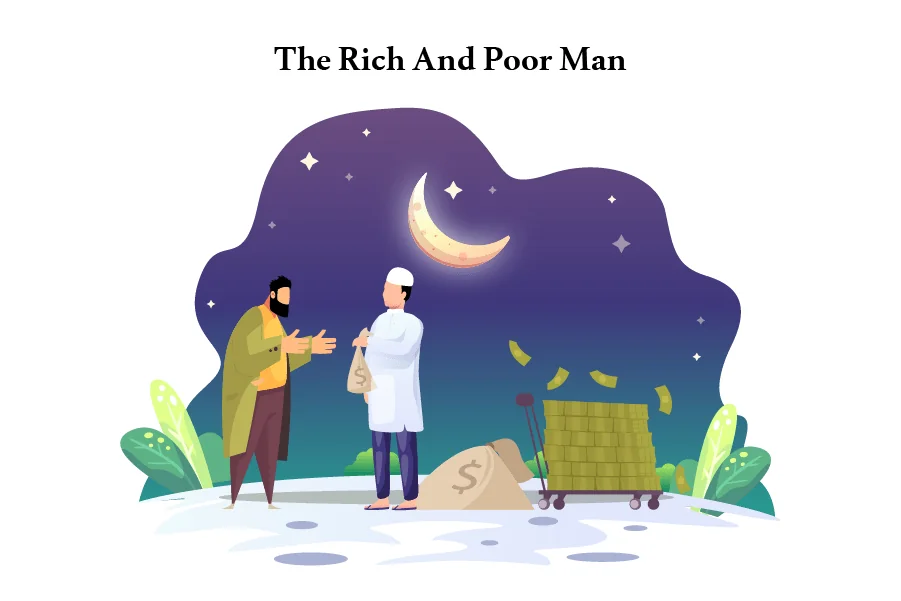
Once the Holy Prophet (PBUH) was in his place, his companions gathered around him to hear the words of knowledge and guidance. It was a usual meeting. Suddenly a poor man in rags appeared and saluted the assembly:
"Salamun Alaikum" (Pbuh)
And then he found g a vacant place comfortably and sat down.
The Prophet (PBUH) had taught them that all Muslims were brothers, and in this assembly, one should sit wherever he finds a place, regardless of any status or creed. Now, it so happened that this poor man was seated with a wealthy man.
Behaviour Of Rich Man And Poor Man:
The rich man felt very worried and tried to collect the edges of his dress around himself so the poor man did not touch his dress. The Prophet (PBUH) observed all this and addressed the rich man. He (PBUH) said:
" Perhaps you are afraid that his poverty would affect you?"
" No, O Messenger of Allah," he replied.
"Then perhaps you were apprehensive about some of your wealth flying away to him?"
" No, O Messenger of Allah." He replied
Prophet (Pbuh) again said:
"Or you feared that your clothes would become dirty if he touched them?"
" No, O Messenger of Allah." The rich man answered
" Then why did you draw yourself and your clothes away from him?"
The rich man said:
"I admit that was the most unwanted thing to do. It was a mistake, and I admit my guilt. Now to make amends for it, I will give away half of my wealth to this Muslim brother so that I may be forgiven."
Just as he said all this, the poor man rose and said,
" O Prophet of Allah, I do not accept his offer."
all the people present there were shocked, they thought that the poor man was a fool, but then he explained that:
" O Prophet of Allah, I refuse to accept his offer because I fear that I might become arrogant and ill-treat my Muslim brothers the way he did to me."
When interacting with individuals facing financial hardship, showing genuine compassion and empathy is key. Respectful communication and thoughtful actions can make a meaningful difference in how they feel. Here are some essential guidelines for building respectful and positive interactions with people experiencing poverty:
1. Listen Attentively
Approach conversations with an open heart and mind, actively listening to what they share. People in difficult situations often appreciate someone who genuinely cares to hear their story without interrupting or rushing to solutions. Being a good listener shows that you value their perspective and are there to support, not judge.Do not be a poor man while listening to others.
2. Avoid Stereotypes and Assumptions
Individuals facing poverty have varied experiences and backgrounds; avoid generalizing or assuming their circumstances. Recognize each person’s journey and refrain from stereotypes that can dehumanize or minimize their experiences. Acknowledge them as individuals with aspirations, talents, and goals.
3. Practice Patience and Understanding
Financial challenges can lead to stress, anxiety, and frustration. Approach interactions with patience and empathy even with poor man. Recognize that a person's mood or response may sometimes reflect the challenges they are going through. Showing understanding in tense moments can create a supportive environment where they feel safe to express themselves.
4. Offer Support Respectfully
If you're in a position to offer assistance, do so in a way that honours their dignity. Avoid condescending language or gestures, and instead, make it clear that your offer is rooted in kindness and not pity. Let them guide the conversation on what type of help they need rather than assuming what might be best for them.
5. Speak Up and Advocate for Change
A meaningful way to support those experiencing poverty (a poor man) is by addressing its larger, systemic causes. Use your voice to support policies and programs aimed at reducing poverty, providing fair wages, and expanding access to quality healthcare and education. Whether through volunteering, supporting local organizations, or staying informed on social issues, your advocacy can contribute to broader societal change.
6. Show Empathy, Not Sympathy
Empathy involves understanding and sharing the feelings of another without judgment or pity. When interacting with people in poverty, focus on connecting with their emotions and experiences on a human level. Empathy fosters a sense of solidarity, showing them that you see them as equals rather than as individuals in need of charity.
7. Express Gratitude and Positivity
In any interaction, acknowledging someone’s efforts, resilience, or positive qualities can be uplifting. A simple acknowledgment of their strength (even to a poor man) in facing adversity can provide a boost to their self-esteem. Expressing genuine gratitude for their presence or sharing positive words can create a warmer, more supportive environment for both of you.
Remember, small gestures of kindness, attentive listening, and respectful communication are powerful tools that foster a deeper understanding of one another. In treating others with dignity, we uplift each other and contribute to a more compassionate, empathetic world.