
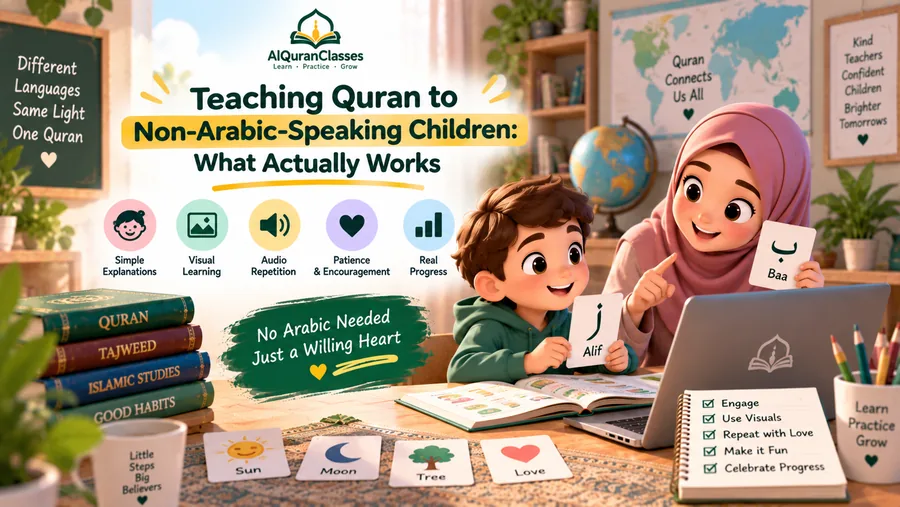
Your child doesn’t need to speak Arabic to learn to read the Quran correctly — the two are genuinely separate skills, and the vast majority of the world’s Muslims read Quran fluently without speaking Arabic as a first or even second language. What matters is learning the sound system through a structured method like Noorani Qaida, taught in a language your child already understands. Here’s how that actually works, and how to support it at home even if you don’t speak Arabic yourself.
The confusion most parents start with
It’s an easy assumption to make: reading Arabic script must require understanding spoken Arabic, the same way reading English requires understanding English. Quran reading doesn’t work that way. It’s closer to learning a precise phonetic code — recognizing letters, sounds, and combinations, and reproducing them accurately — than it is to learning a spoken language for everyday conversation. A child can learn to read Quran with genuine correctness and fluency without holding a conversation in Arabic, because those are two different skills entirely.
Why this is completely normal, not a shortcut
Across the Muslim world, the overwhelming majority of people who read Quran fluently are not native Arabic speakers. Millions of children in South Asia, Southeast Asia, Africa, Europe, and North America learn to read the Quran accurately in a language environment where Arabic isn’t spoken at home at all. This isn’t a workaround for children who “can’t” learn Arabic — it’s simply the normal, standard path for most Muslim families globally, and it works.
How the teaching actually happens
At AlQuranClasses, classes for non-Arabic-speaking children are taught in English — instructions, explanations of rules, encouragement, all of it in a language the child already understands. Arabic is reserved specifically for the Quran text itself: the letters, the words, the recitation. The teacher explains in English what a Tajweed rule means and why it matters, then has the child apply it in Arabic to the actual text. Your child never has to guess at instructions they don’t understand in order to learn the material.
Starting point: Noorani Qaida, regardless of language background
Noorani Qaida is the standard starting point for this exact reason — it isolates letter shapes, sounds, and basic combinations into a structured sequence, taught with English explanation throughout. It doesn’t assume any prior Arabic comprehension, spoken or otherwise. A child who has never heard a word of spoken Arabic and a child raised in an Arabic-speaking household both start the same way: learning the sound of each letter and how it changes in combination.
“But will my child understand what they’re reciting?”
This is the real question underneath the language worry, and it deserves a direct answer: correct recitation and understanding meaning are two separate skills, and it’s completely fine — and completely normal — to build them in that order. Many children (and adults) recite fluently and accurately for years before deepening their understanding of meaning through Tafsir or Translation study. If understanding meaning matters to your family from early on, that’s a real and valid goal too — it’s just a separate course, not a prerequisite for learning to read correctly. AlQuranClasses offers dedicated Quran Translation and Tafsir courses for exactly this, once the reading foundation is solid. See the full course list for how these build on each other.
What if your family speaks a language other than English or Arabic at home?
Right now, instruction is standardized in English rather than matched to each family’s specific home language — so if English isn’t your child’s strongest language either, it’s worth being upfront with the teacher about that during the trial class, so they can adjust their pace and explanations accordingly. Many children in multilingual households manage this well, since a Qaida lesson relies more on repetition and demonstration than complex verbal explanation.
How to support your child at home, even if you don’t speak Arabic
You don’t need to know Arabic to listen for progress. Ask your child to read their current portion out loud to you regularly — you’ll notice hesitation, confidence, and fluency improving over time even without understanding the content yourself.
Learn alongside them, if you want to. Many parents who never learned Arabic growing up start their own Noorani Qaida course as adults, alongside their children. It’s never treated as “starting too late.”
Keep materials visible and routine. The habit-building matters as much as the content — see our 30-minute daily routine guide for a structure that doesn’t depend on you understanding what’s being read.
Ask the teacher directly what’s being covered. A good teacher will happily explain, in plain English, exactly what your child is working on and why — you’re not meant to be locked out of understanding the process just because you don’t read Arabic yourself.
FAQ
Does my child need to know any Arabic before starting? No. Noorani Qaida assumes no prior knowledge of Arabic letters or sounds, and instruction is given in English throughout.
Will my child understand what they’re reciting? Not automatically, and that’s normal — recitation and meaning are separate skills. Understanding meaning can be built later through dedicated Translation or Tafsir courses, once reading fluency is established.
What language are classes taught in? English, with Arabic reserved specifically for the Quran text your child is learning to read.
Are teachers matched to my family’s home language, like Urdu or Bengali? Not currently — teachers are English-speaking, and instruction is standardized in English rather than matched by home language.
What if English isn’t my child’s strongest language either? Mention this to the teacher during the trial class so they can adjust their pace and rely more on demonstration and repetition where needed.
Is it too late for me to learn alongside my child if I never learned Arabic myself? Not at all — plenty of parents start their own Qaida course as adults, learning right alongside their kids.
See how it works with a real class
The clearest way to understand how English-language instruction works in practice is to watch a session. Book a free 30-minute trial — no credit card required — and see how a teacher explains a Tajweed rule in plain English before your child ever needs to.