
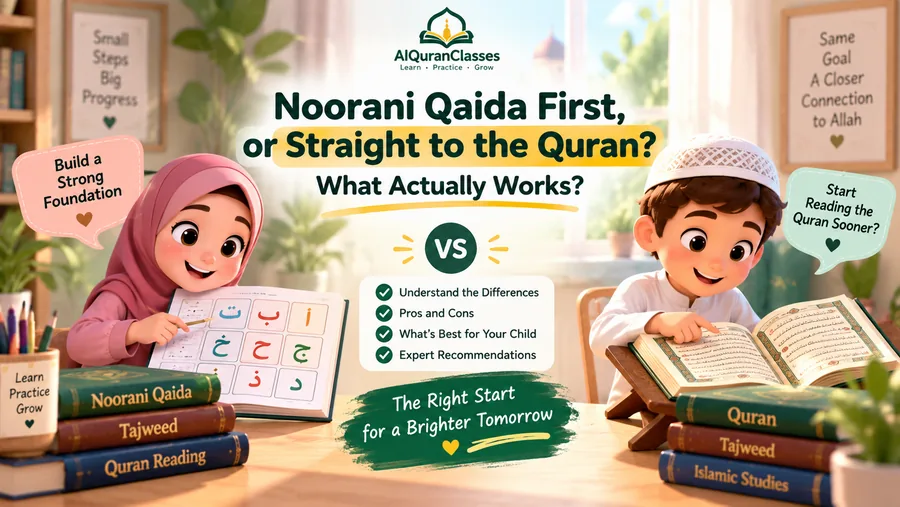
If your child (or you) can’t yet reliably sound out Arabic letters and their combinations, start with Noorani Qaida — it’s not a delay before “real” Quran, it’s the foundation that makes reading Quran correctly possible at all. If you or your child already read Arabic script comfortably, you can often skip straight into Quran reading or Tajweed, confirmed through a level assessment rather than assumed by age.
What Noorani Qaida actually is
Noorani Qaida isn’t a watered-down or “beginner’s version” of the Quran. It’s a short primer that isolates exactly the skills Quran reading depends on: the shape and sound of each Arabic letter, how letters change shape depending on position in a word, how short and long vowels work, and the basic rules of pronunciation (makharij) that determine whether a sound is actually correct — not just close enough.
Skip that foundation, and a student can end up “reading” Quran the way a child might read a language phonetically without understanding it: recognizable, but riddled with small errors in pronunciation that are far harder to unlearn later than to get right from the start.
Why “just start with Quran” backfires more often than it helps
It’s a tempting shortcut — the Quran feels like the actual goal, so Qaida can feel like a stalling tactic. In practice, starting Quran reading without the letter and sound foundation usually means one of two things happens: the teacher ends up teaching Qaida content anyway, just embedded awkwardly inside Quran verses instead of taught cleanly on its own, or the student develops habits — mispronounced letters, ignored elongations, flattened emphasis — that get harder to correct the longer they go unaddressed.
Qaida isn’t slower. It’s usually faster, because it fixes the fundamentals once instead of patching them repeatedly later.
Who should start with Noorani Qaida
A child who is new to Arabic script entirely, regardless of age
A student who can recognize some letters but struggles to read them fluently in combination
Anyone whose pronunciation of Arabic letters hasn’t been formally corrected before, even if they can technically “get through” a page
Who can skip ahead
Not everyone needs to start at the beginning. If a student — child or adult — already reads Arabic script reasonably well, the free trial includes a level assessment specifically to catch this. Where the assessment shows solid existing fluency, a teacher can place the student directly into Quran reading or Tajweed classes rather than restarting from Qaida unnecessarily. The point of the assessment is to meet the student at their actual level, not their assumed one.
How to know which one your child needs, without guessing
Can they identify individual Arabic letters reliably, in and out of order? If not, start with Qaida.
Can they read a full word by sounding out its letters, or do they need each word given to them? Struggling with this points to Qaida.
Has anyone ever formally corrected their pronunciation, or have they largely taught themselves? Self-taught readers often carry small errors worth catching with Qaida review, even if they can technically read.
If you’re genuinely unsure, the trial assessment settles it in one session rather than guessing at home.
What this looks like at AlQuranClasses
Noorani Qaida is taught as its own structured course, building letter recognition and pronunciation in order rather than mixed into Quran text. Students who complete it move into Quran reading and Tajweed with the foundation already in place. Students who arrive already reading well are assessed during their trial and can be placed directly into the appropriate course — see the full course list for what comes after Qaida.
FAQ
Is Noorani Qaida only for children? No. Adults — including reverts and parents learning alongside their kids — go through the same foundation if they’re new to reading Arabic script, regardless of age.
How do I know if my child can skip Qaida? Through a level assessment during the free trial class — a teacher listens to your child read and places them at the right starting point rather than assuming based on age or grade.
Does starting with Qaida mean my child won’t touch the Quran for a long time? No — Qaida is a focused foundation course, not a lengthy detour. Once the letter and sound fundamentals are solid, students move into actual Quran reading.
What if my child already goes to a weekend Islamic school that taught some Qaida? That’s exactly what the trial assessment is for — a teacher can quickly tell whether that foundation is solid enough to build on directly, or whether a few key gaps are worth closing first.
Is Qaida taught differently for a child versus an adult? The content is the same — letters, sounds, and pronunciation rules — but pacing and teaching style adjust to the student. See our Fees page for course and plan options for both.
Find out where to start, for free
A short assessment tells you more than guessing ever will. Book a free trial class and let a teacher tell you honestly whether Qaida or Quran reading is the right starting point.