
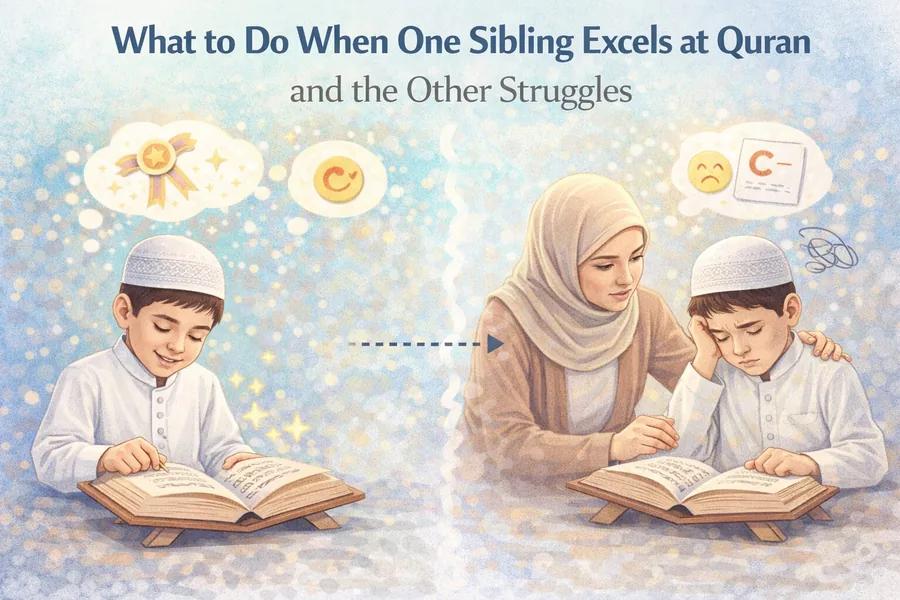
It's one of the quieter heartbreaks of Muslim parenting: two children, same home, same teacher, same schedule — and one is flying through the Quran while the other falls behind. One child recites confidently, remembers new surahs quickly and gets praised often. The other stumbles over the same letters, forgets yesterday's lesson, grows frustrated, and may even start avoiding Quran time altogether.
For many North American Muslim parents, this sibling Quran learning gap can feel confusing, emotional, even scary. You may wonder: “Am I doing something wrong?” “Is one child just more religious?” “Should I push harder?” The truth is reassuring: a sibling Quran learning gap doesn't mean one child is better, smarter or more loved by Allah. It usually means your children have different learning speeds, personalities, confidence levels and emotional needs. One-on-one lessons are built for exactly that: Quran classes for kids at each child’s own pace, with a teacher matched to the child.
Why Does a Sibling Quran Learning Gap Happen?
A sibling Quran learning gap can happen for many reasons. One child may naturally enjoy memorization while another needs more repetition. One may love structure; another learns better through short, playful sessions. One may be older, more focused or more confident with Arabic pronunciation. The gap becomes more noticeable when siblings take classes at the same time, because parents naturally compare progress — even without meaning to. Comments like “Your brother already memorized this” or “Why can't you focus like him?” may seem harmless, but for a struggling child they turn Quran learning into a competition instead of a relationship with the Book of Allah.
The Emotional Side Parents Often Miss
When one sibling excels and the other struggles, the struggling child may feel embarrassed, jealous or “not good at Quran.” Some quietly lose confidence; others act careless because they'd rather seem uninterested than admit they feel behind. This is where the sibling Quran learning gap becomes more than academic — it becomes emotional. A child who feels constantly compared may start connecting the Quran with pressure, shame or failure. That's the opposite of what parents want. The Quran should feel like guidance, comfort and light — not a daily reminder that they're behind someone else.
Stop Comparing, Start Understanding
The first step is to stop measuring both children with the same ruler. Instead of asking “Why is this child not like the other one?” ask “What does this child need in order to learn better?” Maybe they need shorter lessons, visual learning, more review before moving forward, an extra-patient teacher for pronunciation, or a separate class time so they don't feel watched by their sibling. Every child can build a relationship with the Quran, but not every child takes the same path.
Praise Effort, Not Speed
One of the best ways to close a sibling Quran learning gap is to praise effort over results. Instead of “Your brother finished before you,” try “I'm proud that you tried again even though it was hard.” Instead of “Your sister memorized more,” try “You corrected that ayah better today than yesterday.” This teaches children that Quran learning isn't a race — it's about sincerity, patience and steady growth. Some children need to hear often: “You are not behind. You are learning at your pace.”
Give Each Child a Separate Quran Goal
A common mistake is giving siblings identical goals — the same surah, the same number of pages, the same lesson length. This can make the gap worse. Instead, set individual goals: one child memorizes five ayahs; another reviews three with correct Tajweed; one works on fluency; another on confidence and consistency. Both goals are valuable. Both children are moving forward.
Avoid Making the Advanced Child the Standard
It's wonderful when one child excels — celebrate that blessing, but don't turn that child into the family standard. If the struggling child constantly hears “Look at your brother” or “Be like your sister,” they may begin to resent both the Quran and their sibling. A healthier message: “Allah gave each of you different strengths. We are proud of both of you.” This protects the sibling relationship and keeps learning emotionally safe.
Let the Stronger Sibling Help — Carefully
Sometimes the sibling who excels can help the one who struggles, but be careful. If the stronger sibling becomes bossy, impatient or proud, it can widen the gap emotionally. Keep it light: “Can you listen to your brother recite one ayah?” “Can you practice together for five minutes?” “Can you encourage your sister after she finishes?” Make it about teamwork, not correction.
Talk to the Quran Teacher
If your children are in online Quran classes, speak with the teacher privately. A good teacher can tell you whether the struggling child needs more review, a slower pace, pronunciation support or a different teaching style. Tell them: “My children are progressing differently, and I want to avoid comparison. Can we set separate goals for each child?” This matters especially for North American Muslim families, where children already balance school, homework, sports and screen time — Quran learning should fit into real family life, not add stress.
Create a Home Environment That Loves Quran
Parents often focus on class time, but the home environment matters just as much. If the Quran is only discussed through mistakes, tests and progress charts, children feel pressure. If it's part of daily family warmth, they're more likely to stay connected. Try small habits: listen to Quran in the car, read one short surah together after Maghrib, share simple meanings of ayahs, celebrate small improvements, make dua together before class. These moments reduce the pressure around the sibling Quran learning gap and remind children that the Quran isn't just a subject — it's part of who we are as Muslims.
What If the Struggling Child Refuses Quran Class?
If a child starts refusing lessons, don't panic. Refusal often means they feel overwhelmed, embarrassed or discouraged. Instead of forcing immediately, pause and ask gently: “What feels hard about Quran class right now?” “Do you feel nervous when reciting?” “Would it help if we made the lesson shorter?” Sometimes a small adjustment — a slower pace, a kinder tone, a new teacher or a separate class time — helps the child feel safe again.
Keep the Bigger Picture in Mind
The goal isn't for siblings to finish the same surah at the same time. It's for each child to build a lifelong connection with the Quran. Some children bloom early, some later; some memorize quickly but struggle with consistency, others move slowly but develop deep love and respect over time. A sibling Quran learning gap doesn't have to become a family problem — with patience, wise teaching and emotional awareness, it can become an opportunity to understand each child better.
How AlQuranClasses Can Help
At AlQuranClasses, we understand that every child learns differently. One sibling may need advanced reading while another needs patient step-by-step support. Our online classes help Muslim children learn at their own pace with caring teachers who understand the emotional side of Quran learning. For North American Muslim parents, flexible online classes make it easier to give each child the right support without forcing them onto the same path. Whether your child is confident, shy, fast, slow, beginner or struggling, the right teacher can help them move forward with love and confidence.
Final Thoughts
If you're dealing with a sibling Quran learning gap, remember it's not a sign of failure — it's a sign that your children are individuals. Meet each one where they are, celebrate their effort, and protect their love for the Quran above their pace. That love, nurtured patiently, lasts a lifetime.