
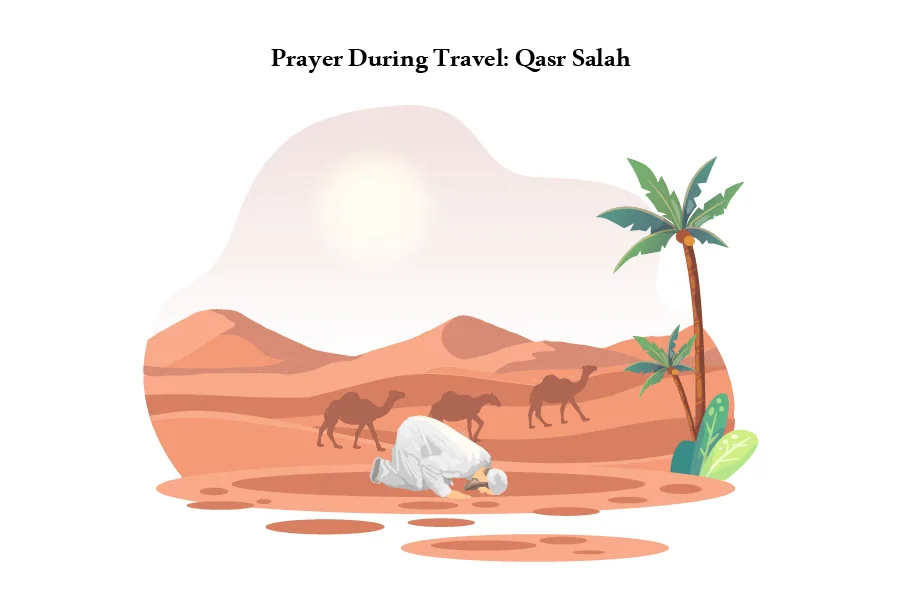
Let's know about Qasr Salah. What is Qasar Namaz? When to pray, Qasar Namaz? And how to pray Qasr Namaz? And what are the Qasar Namaz rules? There are countless reasons Islam is the perfect religion offering the easiest and the most convenient life for all human beings. One of the conveniences it provides is the shortening of obligatory prayers while traveling, known as Qasr Namaz.
How to Pray Qasar Salah:
Allah (SWT) says in Surah 4, Ayah 101:
"And when you travel in the land, there is no sin on you if you shorten your prayer…."
It means that while traveling and while one is a certain distance away from one's hometown, one can shorten four Rakat fard prayers (Dohr, Asr, and Isha) to two Rakat prayers. It is a blessing of Allah (SWT) for which one must ever be grateful. Once Umar bin al-Khattab (RA) was asked about this favor, and he said the Prophet (PBUH) told him:
"This is a charity Allah (SWT) has given to you, so accept His charity."
(Sunan Abu Dawud: Vol. 1, 1199).
However, there is no Qasr for Fajr and Maghrib.
When Qasr Salah applies:
How far does a person have to be from his hometown to qualify for this concession? The answer to this question could be found in the hadith collected by Imam Bukhari, in which Ibn Umar (RA) and Ibn Abbas (RA) reported to have offered Qasr Salah in a journey of four Burud, i.e., sixteen Farsakh (one Farsakh = 3 miles).
How many days can a person shorten prayers while on a voyage? The answer is nineteen days, which was the practice of the Prophet (PBUH) as stated by Ibn Abbas (RA):
"The Prophet (PBUH) once traveled, stayed for nineteen days, and offered shortened prayers. So when we traveled (and stayed) for nineteen days, we used to shorten the prayer, but if we traveled (and stayed) for a longer period, we used to offer the full prayer."
(Saheeh Al-Bukhari, Vol. 2, 1080).
When and where can one return to the whole prayer?
The answer to the issue is traced back to the hadith collected by Imam Bukhari in which he reported Ali bin ibn Talib's return to Kufa after leaving the city.
"Once Ali bin Abi Talib (RA) left Kufa and started shortening his prayers although the houses (of Kufa) were [still] in sight. On his return, he was told, "This is Kufa." (So that he would no longer shorten the prayer). He said, "No, [I will go on shortening the prayers] till we enter Kufa."
(Saheeh Al-Bukhari, Vol. 2, Book 18, Chapter 5).
Another advantage of the Qasr Salah is permission to combine two prayers. Ibn Abbas (RA) and Anas bin Malik (RA) reported that
"The Prophet (PBUH) combined Dohr, Asr, Maghrib, and Isha prayers on a journey."
(Saheeh Al-Bukhari, Vol 2, 1107 and 1108).
In short, Qasr Salah is a great blessing of Allah (SWT). A clear proof among the many explanations that Allah (SWT) does not burden a person beyond his/her capacity. He is the Creator, and He knows our limitations and needs. Qasr Salah is but an expression of His infinite mercy for the Believers. Knowing when it applies, and for how long, means learning the rulings that govern it. There is no reason why we shouldn't avail of this concession. There's every reason to be grateful to Allah (SWT) for this and every other convenience He generously granted us.
Qasr Salah is a profound reminder of Allah’s infinite mercy and His deep understanding of human limitations. By allowing the shortening of prayers during travel, Allah (SWT) demonstrates His care for our well-being, encouraging us to maintain our connection to Him even in times of difficulty or change.
This ruling emphasizes that Islam is a faith of ease, removing undue burdens while keeping the focus on spiritual devotion. Teaching our children about Qasr Salah is an opportunity to show them how their Creator is always considerate of their circumstances, fostering a relationship built on love, trust, and gratitude for His mercy.
In a fast-paced world where travel and commitments can sometimes make worship challenging, Qasr Salah is a beautiful expression of Allah’s compassion, ensuring that worship remains achievable for everyone. By practicing and teaching the rulings of Qasr Salah, we not only help our children understand the flexibility of Islamic teachings but also encourage them to reflect on Allah’s countless blessings in their lives.
This awareness nurtures a sense of thankfulness and strengthens their relationship with their faith, guiding them to appreciate and love Islam as a source of ease and comfort. How do you teach your children about such blessings in Islam? Share your thoughts below!