
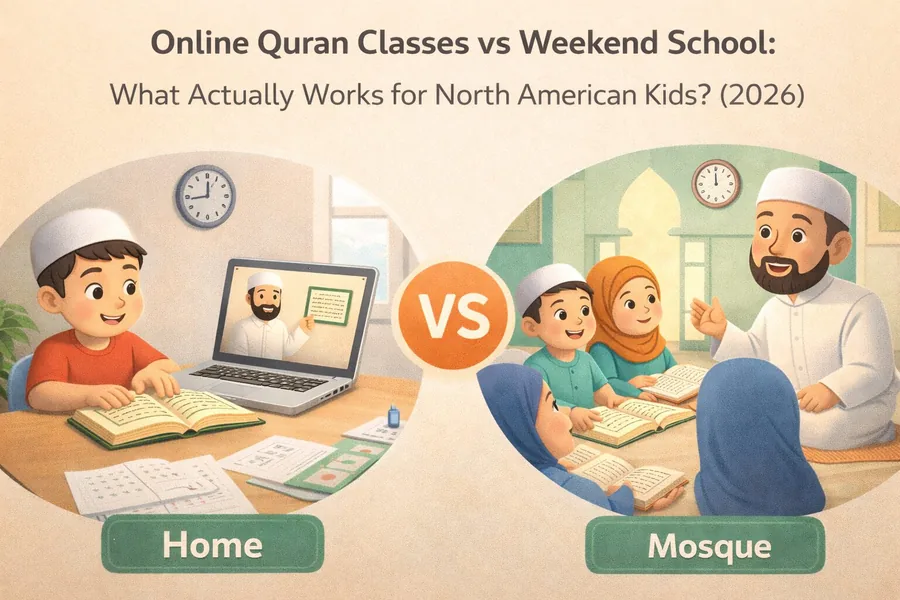
Parents across the U.S. and Canada keep asking the same question: online Quran classes vs weekend school—which one builds real Quran progress without burning kids out? A Saturday program at the masjid offers community and routine. Online Quran classes offer flexibility and personalized teaching. Most families don’t need a “perfect” option. Most families need a realistic option that works with public school, sports, homework, winter weather, and family energy. A clear decision becomes easier when parents compare online Quran classes vs weekend school using the daily reality of North American life, not ideals.
Why the Choice Feels Hard for Parents in USA & Canada
A typical Quran school in USA runs on limited hours, crowded classrooms, and volunteer capacity. A typical weekday routine runs on early mornings, after-school pickups, homework battles, and bedtime deadlines. Weekend school feels like the “Islamic anchor,” yet kids often arrive tired and distracted. Online learning feels easier logistically, yet parents worry about screen time and social growth. A fair comparison of online Quran classes vs weekend school starts with one truth: Quran learning needs consistency more than intensity. If online wins for your family, here is how to choose online Quran classes for kids between the providers on offer.
Quick Comparison: Online Quran Classes vs Weekend School
| Factor Parents Care About | Weekend School (Masjid) | Online Quran Classes |
|---|---|---|
| Social environment | Strong friendships, community vibes | Limited peer contact unless group classes |
| Teacher attention | Often 15–25 kids per class | Often 1-to-1 or small groups |
| Consistency | Depends on attendance, weather, traffic | Easier weekly consistency from home |
| Time cost | Commute + waiting + drop-off/pickup | Class starts on time, no driving |
| Learning pace | Usually one pace for the whole class | Personalized pace per child |
| Tajweed correction | Hard in noisy rooms | Clear audio + focused correction |
| Parent visibility | Limited feedback, depends on system | Progress reports, lesson notes, recordings (varies by platform) |
| Kid energy level | Often low after a full school week | Better when scheduled around child’s best focus window |
| A strong choice depends on child temperament and home routine. Parents weighing online Quran classes vs weekend school should treat the decision like choosing a learning system, not choosing a “better Muslim parent” badge. |
Honest Pros and Cons: Weekend School at the Masjid
Real pros
Community builds identity. Kids see other Muslim kids, hear the adhan, join group duas, and feel “normal” in their faith.
Masjid routine builds belonging. A child connects Islam with a physical place, not only a screen.
Group learning builds teamwork. Some kids learn faster when peers recite beside them.
Real cons
Large classes reduce correction time. One teacher correcting Tajweed for 20 kids turns into “survive the hour,” not “master the makharij.”
Traffic and weather drain family energy. A winter drive in Canada or a long weekend commute in the U.S. turns Quran learning into a struggle before class begins.
Mixed skill levels slow progress. A child who needs Noorani Qaida sits beside a child doing Juz’ memorization, so teachers choose “average pacing.”
Homework-style fatigue shows up. A full week of school makes Saturday feel like punishment for many kids.
Weekend programs still matter, yet parents comparing online Quran classes vs weekend school need to acknowledge classroom reality.
Honest Pros and Cons: Online Quran Classes
Real pros
1-to-1 attention changes outcomes. A teacher can correct every mistake, not every fifth mistake.
Flexible scheduling fits North American life. Classes can happen after dinner, before school, or on lighter homework days.
Fewer distractions improve focus. A quiet room and headphones often beat a loud classroom.
Progress becomes measurable. Many online Quran classes offer lesson summaries, attendance logs, and teacher notes, so parents see what improved.
Real cons
Screen fatigue exists. A child who spends all day on devices may resist another online session.
Social learning drops. Friendships and masjid bonding don’t happen naturally on Zoom.
Parent setup matters. A quiet space, stable internet, and gentle supervision make a big difference.
Quality varies by provider. Some platforms run like real schools; others feel like random tutoring.
Parents weighing online Quran classes vs weekend school often land on online learning when consistency and correction matter most.
What Works Best by Child Type
Kids who thrive in weekend school
Social kids who learn through group energy.
Kids who need the masjid environment to feel motivated.
Families already committed to weekly masjid life and volunteering.
Kids who thrive in online Quran classes
Kids who need patient repetition and personal correction.
Kids who struggle in noisy rooms or feel shy reciting in front of big groups.
Families balancing sports, tutoring, long commutes, or rotating work shifts.
A single “winner” rarely exists in online Quran classes vs weekend school. Fit matters more than ideology.
Mini Case Study 1: U.S. Public-School Kid With a Packed Week
Ayaan, age 9, attends public school in Illinois. Soccer practice runs twice a week. Friday nights run late. Saturday school starts at 10 a.m., yet the family spends 45 minutes driving and another hour waiting. Ayaan’s class has 18 kids. Tajweed correction happens once or twice per session.
Ayaan’s parents tried a hybrid approach: weekend school for community, plus two short weekday online Quran classes for focused reading and Tajweed. Progress improved because weekday sessions stayed calm, short, and consistent. Weekend school became more about identity and less about “catching up.”
Mini Case Study 2: Canadian Family With Long Winters and Early Sunsets
Maryam, age 7, lives in Alberta. Winter brings snow, slippery roads, and early darkness. Weekend Quran school becomes stressful for parents and tiring for kids. Missed weekends stack up fast.
Maryam’s family shifted core learning to online Quran classes during winter months, then returned to weekend school in spring for community events. Maryam responded well to one-to-one sessions because a teacher could repeat lessons without classroom pressure. Winter stopped being a barrier to Quran consistency.
Mini Case Study 3: Two Kids, Two Different Needs in One Home
A family in New Jersey has two children: an 11-year-old who loves the masjid and an 8-year-old who feels anxious reciting in groups. Weekend school works for one child and frustrates the other.
Parents chose weekend school for the older child and online Quran classes for the younger child. Family peace improved because each child learned in the environment that matched temperament.
Real homes often prove one point: online Quran classes vs weekend school doesn’t need a one-size decision.
A Practical Decision Checklist for Parents
Parents deciding between online Quran classes vs weekend school can use these questions as a fast filter:
Does a child need 1-to-1 correction to move forward?
Does a child crave friends and masjid connection to stay motivated?
Does weekend traffic or winter weather cause missed classes?
Does a child shut down in group recitation settings?
Does a family schedule allow consistent Saturday attendance for 9 out of 10 weeks?
Does a parent want progress tracking and structured feedback?
Answers usually point to one of three outcomes: weekend-only, online-only, or a hybrid routine.
Best Answer for Many Families: A Hybrid Routine
Many North American families get the best results from a blended plan: weekend school for community, weekday online sessions for skill-building. Quran fluency improves through repetition and correction, which online learning supports well. Islamic identity grows through masjid friendships and shared experiences, which weekend school supports well.
A hybrid plan often resolves the tension behind online Quran classes vs weekend school without forcing parents to choose one forever.
Already Doing Weekend School? Use AlQuranClasses to Fill the Weekday Gaps
Weekend school can build love for the masjid. Weekday practice builds actual momentum. Parents who already use a Quran school in USA can use AlQuranClasses as the weekday support system:
Short weekday sessions for Tajweed correction and reading fluency
1-to-1 attention for kids who fall behind in large classes
Flexible scheduling around homework, sports, and family routines
Progress visibility so parents know what changed week to week
A simple approach works well: keep weekend school for social and spiritual connection, then add AlQuranClasses on weekdays for focused learning. Families searching online Quran classes vs weekend school often discover a better question: “Which mix keeps Quran learning consistent for my child?”