
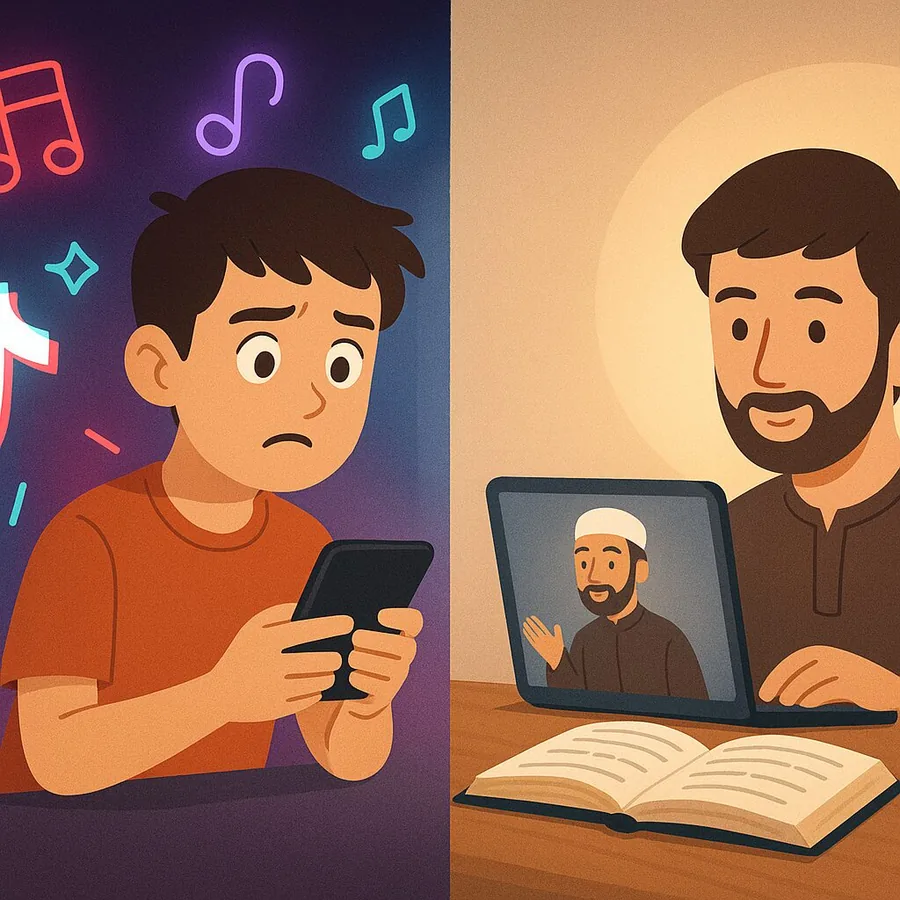
Introduction: The Allure of Islam Through TikTok
For today’s generation of Muslim youth, TikTok has quietly become a modern madrasa — not in the traditional sense, but as a space where religion, identity, and digital culture collide. In our hyper-connected world, where screens shape thought and rhythm dictates belief, many young Muslims turn to short-form platforms to explore faith. A 30-second clip can introduce a child to a new hadith, a trending dua, or a condensed commentary on a Quranic ayah. The content feels relatable, quick, and easily digestible. It appears to offer what traditional learning sometimes doesn’t: speed, convenience, and instant emotional reward.
What we now see as Islam Through TikTok is part of a larger cultural shift — faith filtered through algorithms, soundbites, and trends. Children and teens, raised in the age of swipes and hashtags, find faith presented in the same way as dance challenges or recipe hacks. When a friendly influencer talks about patience while trending music plays softly in the background, it feels accessible, almost comforting. But this fast-paced spiritual consumption comes with a cost. Learning Islam through TikTok often means receiving information stripped of depth — short verses without tafsir, rulings without context, reminders without reflection.
Many kids mistake exposure for understanding. Without scholarly guidance or textual grounding, their grasp of faith becomes scattered and fragile. They absorb fragments instead of frameworks. In a recent media literacy study by the University of Birmingham (2023), researchers found that over 60 % of Muslim teens in the West said TikTok was their primary source of Islamic reminders — yet fewer than 20 % could recall the source or authenticity of the information they consumed.
The research highlights a concerning gap between access and understanding. In this article, we’ll examine what happens when children rely solely on TikTok for Islamic knowledge, how this trend reshapes their connection to faith, and how structured Quran and Arabic learning can restore the depth and authenticity missing in the scroll. Structured does not have to mean dull: a structured Islamic Studies course for kids takes a child through the pillars, the Seerah and good character in order, with a teacher to answer the questions a feed never does.
Section 1: Why “Islam Through TikTok” Seems Attractive to Kids
For digital natives, TikTok is more than an app; it’s a daily companion. Its short, dynamic format aligns perfectly with the way young minds today process information — fast, visual, and emotionally stimulating. The platform’s design activates the brain’s dopamine circuits, rewarding each swipe with novelty and engagement. When religious content enters that cycle, it feels effortless to consume and emotionally uplifting to watch. Psychologists call this the “micro-learning illusion”: the belief that small bursts of information equal mastery of a topic.
For children and teens, this illusion is powerful. Watching a one-minute explanation about salah, or a creative recap of the story of Prophet Yusuf (AS), provides a sense of accomplishment — as if they’ve truly learned something substantial. This sense of instant reward makes Islam Through TikTok both appealing and habit-forming. Beyond neuroscience, there’s also emotional relevance.
Faith content on TikTok often comes wrapped in relatability — a young Muslim creator sharing their journey, struggles, or reflections in casual language. That peer-to-peer tone bridges the psychological gap between formal religious instruction and everyday experience. Children relate more to someone saying, “Here’s how I make wudu before class,” than to an abstract explanation from a book. Sociological research supports this phenomenon. During the pandemic, when in-person religious classes paused, many students turned to TikTok to fill the void. A 2021 study in the Journal of Islamic Education and Technology reported that more than 70 % of Muslim youth in Southeast Asia used TikTok as a tool for learning about fiqh, aqidah, and Quranic values.
They cited its visual storytelling and brevity as the primary reasons. Similar patterns have emerged in Canada, the UK, and the US, where young Muslims spend an average of two hours daily on TikTok, often encountering faith-related content through hashtags like #IslamicReminders or #RamadanVibes. For many, “Islam Through TikTok” has become not just an entry point but the dominant mode of spiritual exposure.
The algorithm personalizes the feed to reinforce the viewer’s interests — meaning that once a child watches one Islamic video, dozens more follow. What starts as curiosity becomes routine. Yet, in this very convenience lies the danger: children begin to equate scrolling with studying, viewing with understanding, and emotion with knowledge. The beauty of TikTok lies in its accessibility; the risk lies in its reductionism. Faith becomes quick, clickable, and fleeting — a stream of sacred content that moves as fast as the user’s thumb.
Section 2: The Risks of Relying Only on TikTok for Islamic Education
2.1 Superficial Understanding
Because videos are short and optimized for entertainment, complex Islamic topics get oversimplified. Children may learn that “pray five times” or “avoid haram” but miss the deeper context of why, how, and when. Without proper guidance, their understanding remains superficial.
2.2 Credibility Issues and Misinformation
Not all creators are qualified scholars. One study indicated that while 88 % of students felt more motivated after consuming TikTok religious content, concerns remained about the credibility of that content. Letiges eJournal Children may inadvertently absorb incorrect interpretations or cultural opinions presented as Islamic fact.
2.3 Lack of Structured Learning
TikTok doesn’t provide a structured syllabus. There’s no guaranteed progression from basic Islamic concepts to more advanced ones. Without structure, the learning remains fragmented and children may struggle to connect lessons or build consistent practice.
2.4 Algorithmic Bias and Distraction
Social media algorithms prioritize what keeps users engaged. A child looking up a prayer video may be next shown entertainment, challenges or irrelevant content. Studies of platforms like TikTok show that value transmission through short-form videos can be inconsistent and unpredictable. arXiv+1
2.5 Missed Opportunities for Depth and Skills
Learning Islam is not only about memorising dua or stories — it also involves Arabic reading, Quranic recitation (Tajweed), memorization (Hifz), understanding of Tafsir, and application of Sunnah. Many of these skills require guided practice, feedback and interaction. When kids learn Islam through TikTok alone, they may miss out on these essential components.
Section 3: How Online Quran & Arabic Classes Provide a Better Path
3.1 Structured Curriculum and Qualified Tutors
At platforms like AlQuranClasses, children follow a structured program that builds foundational skills step‐by‐step: Arabic alphabet → Tajweed → Quranic recitation → meaning and application. This contrasts with the random, standalone videos typical of “Islam Through TikTok.”
3.2 Interactive Learning and Personalized Feedback
Unlike passive video scrolling, online classes allow children to practice, ask questions, and receive real-time correction. For example, a tutor can correct pronunciation, guide memorisation, clarify meanings and track progress. This ensures that the child moves from “struggle with Arabic or Quran” toward clarity and confidence.
3.3 Safe, Focused Environment
Online classes offer a space dedicated solely to Islamic learning, free from distractions, trends and algorithmic detours. Children engage in lessons with peers and tutors who share their values, reinforcing learning rather than just browsing content.
3.4 Depth of Understanding and Application
With proper classes, kids not only memorize verses or duas but also learn the why and how: Why do we pray? How is the Quran organized? How do we apply sunnah in daily life? This depth transforms faith learning from passive absorption into active, meaningful engagement.
3.5 Consistent Practice and Accountability
Regular sessions, practice assignments, progress reports — these features keep children accountable. Unlike the sporadic browsing typical of social media, this structured approach builds habits. Over time, children mature beyond simply watching content into living the teachings of Islam.
Section 4: Bridging the Gap — Using TikTok Smartly, Without Making It the Sole Source
4.1 Use Short-form Media as Supplement
TikTok can still serve as a helpful supplement for motivation, inspiration or quick reminders. But it should not be the only source of Islamic education.
4.2 Vet Content Creators
When children explore Islam Through TikTok, parents and educators should guide them to channels endorsed by qualified scholars, check for references, and discuss the content together.
4.3 Combine Media with Structured Learning
Enroll your child in a formal class (like those at AlQuranClasses), and use TikTok for extra inspiration. Discuss videos watched, evaluate them in light of deeper study, and reinforce lessons through real-world practice.
4.4 Engage in Family Learning
Parents and children can watch short Islamic content together, talk about it, then deepen it through class discussion or Quran reading. This integrated approach prevents the “one‐sided” consumption of faith via TikTok.
Conclusion: From TikTok Trends to Timeless Truths
The concept of Islam Through TikTok reflects a modern reality: children are digital natives, and social media will influence how they access faith. But when it remains the only pathway, they miss out on the depth, structure and authenticity that Islam demands. When kids rely solely on short-form content, they risk superficial faith, mis-information and missed opportunities for real engagement.
By contrast, structured online Quran and Arabic classes — like those offered at AlQuranClasses — transform learning from trend-based to timeless. Children gain not just verses and stories, but skills, understanding, discipline, and a living connection to the Quran and Sunnah. In doing so they move from passive observers of faith to active participants — from “learning Islam through TikTok” to living Islam through knowledge and application.
✨ Help your child move beyond the surface. Enroll in AlQuranClasses and give them the complete Islamic education they deserve — one built on guidance, depth and the beauty of the Quran.