
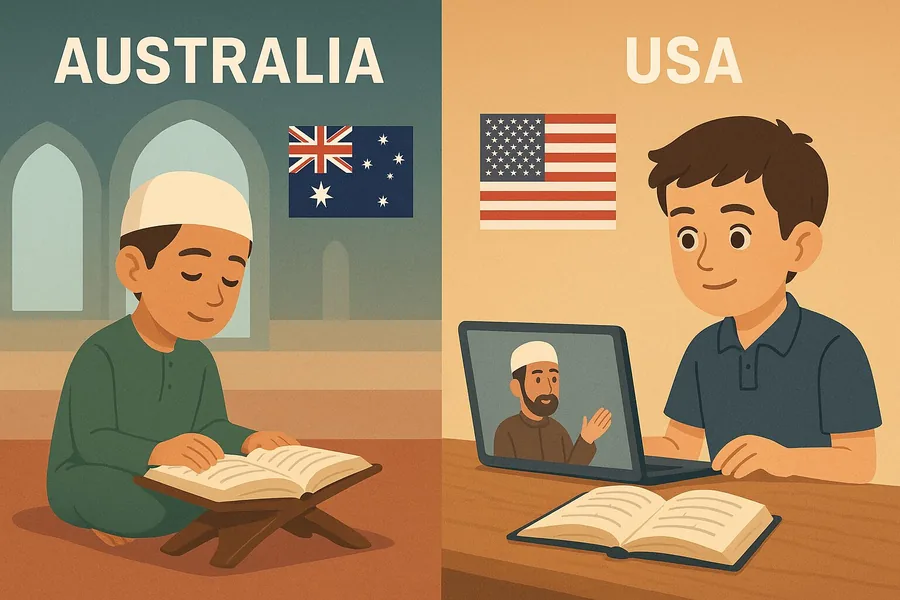
Across the Muslim world, Quran learning has always been a sacred journey. But in countries like Australia and the United States, that journey takes on unique forms. The cultural, educational, and social environments in which children grow up shape how they approach religious learning. While both Australian and American Muslim communities are deeply committed to nurturing Quranic literacy in the next generation, their children learn the Quran differently — not in faith or intention, but in environment, exposure, and experience.
Diverse Muslim Communities, Shared Faith
Australia and the United States both host vibrant Muslim populations, but their community structures differ in size, diversity, and history. In Australia, Muslims make up roughly 3.2% of the population, concentrated mainly in cities like Sydney and Melbourne. The Muslim community there has deep roots from Lebanon, Turkey, Pakistan, and Indonesia. In contrast, Muslims in the USA form around 1.3% of the population, with diverse origins — including South Asia, the Middle East, and Africa — spread widely across the country.
This demographic difference shapes how children learn the Quran differently in both regions. In Australia, smaller yet closely-knit communities often emphasize mosque-based programs and weekend schools that function as community anchors. Parents value these intimate, culturally grounded spaces where children form friendships while learning Arabic and Quranic recitation. In the U.S., large metropolitan areas like Chicago, Houston, and New York host extensive Islamic centers and online academies that cater to varied cultural backgrounds. American Muslim parents, juggling fast-paced schedules and longer commutes, often opt for online Quran classes that fit their family’s rhythm. The result is two parallel approaches — one grounded in local community bonds, the other thriving through digital flexibility.
Educational Environments Shape Learning
Public schooling systems in both countries play a critical role in how children learn the Quran differently. In Australia, many Muslim children attend Islamic schools that integrate Quranic learning directly into their curriculum. This structure allows daily exposure to Quranic values, memorization, and Arabic studies alongside academic education. According to research published by the Australian Journal of Islamic Studies (2022), over 70% of Muslim parents prefer schools where Islamic identity and Quranic instruction are naturally embedded.
By contrast, American Muslim families often rely on supplementary learning outside regular school hours. While Islamic schools do exist in the U.S., the majority of Muslim children attend public schools, meaning Quran learning typically happens in the evenings or weekends. Online programs like AlQuranClasses.com fill this gap, offering structured yet flexible schedules. This difference highlights how children learn the Quran differently not by desire, but by educational opportunity. For families filling that gap outside school hours, online Quran classes for kids are one-on-one, so they fit around the school day wherever you live.
Cultural Attitudes Toward Faith and Discipline
Culture deeply influences motivation. In Australia, children grow up in a society where religious expression is visible and multiculturalism is celebrated through community events. Islamic centers often host Quran competitions, storytelling sessions, and family camps that bring religion to life. Kids learn through group engagement — reciting together, memorizing as teams, and celebrating milestones collectively. In contrast, many American Muslim families experience a more individualistic social environment.
Children are encouraged to pursue personal growth and independent learning. This cultural difference affects how they learn the Quran differently. American students often rely on one-on-one online tutoring and personalized pacing, while Australian kids engage more frequently in group recitations and peer learning. Both approaches nurture commitment — one through community bonds, the other through tailored guidance.
Role of Technology and Online Platforms
Technology has become a great equalizer. Whether in Sydney or Seattle, children now have access to the Quran from their living rooms. However, their use of technology still reflects regional preferences. Australian families increasingly blend in-person and online classes, preferring hybrid setups that maintain human connection while ensuring convenience. American parents, on the other hand, lead the global trend in fully digital Islamic education. Surveys by Pew Research (2023) show that over 60% of American Muslim parents have enrolled their children in at least one online Quran class since 2020.
This shift means American kids learn the Quran differently — they rely more heavily on technology-driven engagement, interactive platforms, and gamified memorization tools. Programs like AlQuranClasses.com provide real-time feedback, Tajweed correction, and progress tracking that match this learning style, turning digital education into spiritual growth.
Parental Involvement and Home Environment
Another key factor in how children learn the Quran differently is parental involvement. In Australia, many families live in close proximity to extended relatives, providing an environment where grandparents and elders actively reinforce Quran learning at home. Family recitations after Maghrib or weekend group halaqas are common. This intergenerational reinforcement strengthens retention and builds emotional attachment to the Quran. In the U.S., however, nuclear family structures dominate. Parents often balance demanding work schedules, leaving less time for in-person Quran supervision. Yet American families compensate with technology — setting digital reminders, accessing recorded lessons, and monitoring children’s progress through learning apps. The difference doesn’t lie in dedication but in lifestyle — both environments reflect love for the Quran, expressed in distinct forms.
Emotional Connection and Identity
For Muslim children in both nations, Quran learning is not just about memorization — it’s about identity. In Australia, where Islamic culture is visibly woven into public life, kids often feel proud sharing their faith openly. School assemblies may include Eid celebrations, and multicultural awareness creates space for visible Islamic identity. In the U.S., some children may initially feel hesitant to express faith due to societal misconceptions, but structured Quran classes help them regain confidence. When they connect Quranic lessons to daily life, they begin to see Islam as a source of empowerment rather than difference. This psychological connection ensures that children don’t just recite but internalize — that they learn the Quran differently in depth and purpose.
How Quran Classes Bridge the Differences
While children in Australia and the USA may learn the Quran differently, the ultimate goal remains the same: to understand, live, and love the words of Allah. Online Quran programs like AlQuranClasses.com unify these diverse approaches. Australian families benefit from consistent access when local programs are unavailable, while American families find structure in their flexible schedules. Our certified tutors adapt to both cultural realities — blending discipline with warmth, structure with flexibility, and memorization with meaning. Whether a child learns through hybrid sessions in Melbourne or digital lessons in Dallas, what matters is connection — not geography. At AlQuranClasses, every lesson builds fluency, comprehension, and emotional resonance, helping each student discover their personal journey within the timeless rhythm of the Quran.
Conclusion
Children across the world may learn the Quran differently, but every sincere effort leads to the same sacred destination — a heart connected to Allah and a soul illuminated by His words. No matter the method, whether a child recites under a teacher’s guidance in a Sydney mosque or learns through a screen in an American suburb, the Quran remains the unifying thread that ties generations, cultures, and hearts together. In Australia, the community-based approach nurtures togetherness.
Children grow in an environment where learning is intertwined with friendship, gatherings, and shared reflection. The sound of group recitations echoing in community halls fills young minds with a sense of belonging. They experience the Quran not only as a book to study but as a shared rhythm of life.
Across the ocean, in the United States, technology reshapes the learning experience. Children sit before glowing screens, their tutors guiding them through tajweed, pronunciation, and memorization. Each verse they master reflects discipline, focus, and self-drive — qualities shaped by a culture that values independence and personal achievement. Both worlds, though different in rhythm, pursue the same melody of divine connection. What this diversity teaches us is that there is no single correct way to learn the Quran differently. Islam has always embraced adaptability; its message transcends borders and time zones. When children in one part of the world learn through in-person circles and others through virtual classrooms, it’s not a divide — it’s proof of Islam’s universality.
The Quran was revealed for all people, in all eras, and its message continues to find new ways to reach every heart willing to listen. Yet, what truly shapes the outcome isn’t geography or method — it’s the consistency of effort, the purity of intention, and the love with which parents and teachers nurture that learning. When a child recites even one verse with understanding, angels bear witness. When a parent creates a home where the Quran is heard daily, that home becomes a place of light. These moments of devotion — big or small — build the foundation of a generation that carries faith with conviction.
That’s why choosing the right guidance matters. Structured, supportive learning ensures that a child doesn’t just memorize but understands, applies, and cherishes what they recite. At AlQuranClasses.com, every lesson is designed to honor that purpose. Our tutors combine tradition with innovation, allowing children to learn the Quran differently but effectively — with heart, discipline, and joy. Whether your child joins from Australia, the USA, or anywhere in between, they’ll find a nurturing space to grow in both knowledge and faith.
The Quran’s beauty lies not in how it’s taught but in how it transforms those who learn it. Help your child experience that transformation. Enroll them at AlQuranClasses.com today and give them the opportunity to connect with the Quran in a way that fits their world — guided by faith, grounded in excellence, and inspired by love for Allah’s words.