
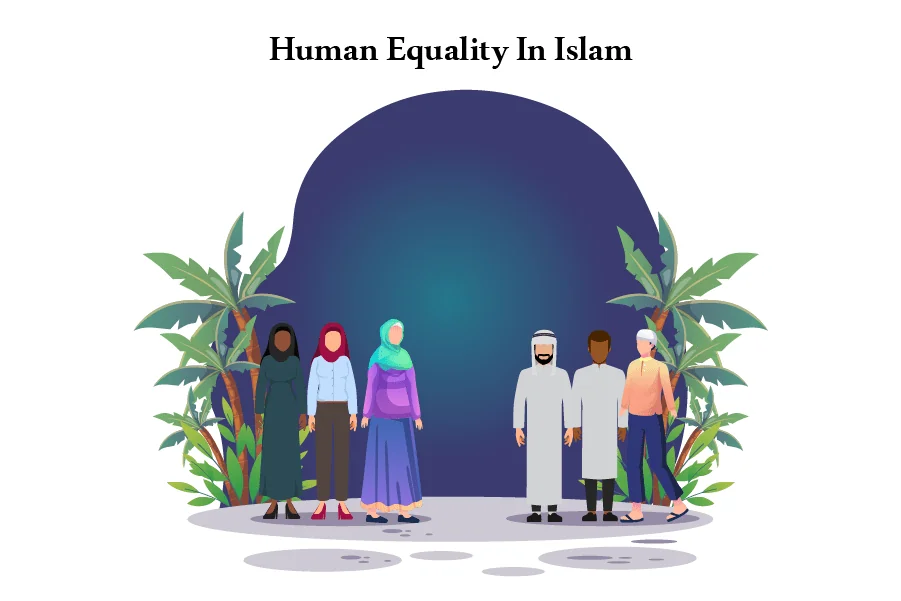
Human Equality In Islam, all humans are equal regarding their inherent dignity and worth as beings created by Allah. The Quran states:
يَٰٓأَيُّهَا ٱلنَّاسُ إِنَّا خَلَقْنَٰكُم مِّن ذَكَرٍ وَأُنثَىٰ وَجَعَلْنَٰكُمْ شُعُوبًا وَقَبَآئِلَ لِتَعَارَفُوٓا۟ ۚ إِنَّ أَكْرَمَكُمْ عِندَ ٱللَّهِ أَتْقَىٰكُمْ ۚ إِنَّ ٱللَّهَ عَلِيمٌ خَبِيرٌ
"O mankind, indeed We have created you from male and female and made you peoples and tribes that you may know one another. Indeed, the noblest of you in the sight of Allah is the most righteous of you. Indeed, Allah is Knowing and Acquainted."
(Quran 49:13)
The teachings of Islam emphasize that all people, regardless of their race, ethnicity, gender, or social status, are equal in the eyes of Allah. No one is superior to another based on their birth or external circumstances.
Human Equality means that Muslims are equal in their religious obligations and are treated equally under Islamic law. Everyone should be treated with dignity and respect, regardless of background or circumstances.
Additionally, Islam teaches that social and economic justice is essential and that everyone should have equal opportunities and resources. It includes the fair distribution of wealth, protecting the rights of the poor and marginalized, and promoting Human equality and justice in society.
The Story of Hazrat Umar (RA) on Human Equality
One day, a man went to 'Umar (the Amir ul Mumineen) and complained about Hazrat Ali.
Court proceedings then followed:
The man who complained appeared before 'Hazrat Umar as the plaintiff in the case, and Hazrat Ali, appeared as the defendant.
When two litigants stood before him, 'Umar turned to 'Ali and said,
"Be equal with your opponent, O Abu Hasan."
Perhaps Hazrat 'Umar felt that Hazrat' Ali was not standing exactly parallel (equal) to the plaintiff. Whatever the case, Hazrat' Umar, from the outset, was making it clear that he was not going to take sides and that both litigants went equal in the eye of the law.
Hazrat' Ali's face expressed anger when Hazrat' Umar uttered the above command.
The proceedings continued until Hazrat' Umar issued his verdict in the case; afterward, Hazrat' Umar said to Hazrat' Ali,
"O Abu Hasan, did you become angry because I treated the two of you as equals?"
"No, O Leader of the Believers! Rather, I became angry because you did not treat my opponent and me equally! You honored me when you called me by my kunya (Abu Hasan). But you did not call my opponent by his Kunyah (instead, you called him by his proper name)."
At this, Hzrat' Umar then kissed Hazrat' Ali on his head and said,
"May Allah not keep me alive on a land upon which there is no Abu Hasan!"
All Human Equality in the light of Islam.
No Gender Discrimination in Islam:
The Quran stays that both genders are deliberate and independent.
Our deeds do not judge us unless we have the freedom of choice to do so. This free choice carries the responsibility to make the right choices or pay the consequences for the wrong ones.
Most Islamic rulings apply to men and women equally, and their obligations towards one another bind both.
Men and women are two equally important parts of humanity. The rights and responsibilities of both genders are equal and balanced in Islam. Though their obligations might differ according to physical and psychological differences in some regions of life. Each is equally accountable for their particular responsibilities.
No Racism in Islam
Racism is strictly prohibited in Islam. The religion teaches that all humans are equal regarding their inherent dignity and worth as beings created by Allah.
All people, regardless of their race, ethnicity, or color, are considered equal in the eyes of Allah and should be treated as such. Racism, which is based on the belief in the superiority of one race over another, is entirely at odds with the teachings of Islam.
In Islam, there is a strong emphasis on compassion, justice, and treating human with equality, respect and dignity. The Prophet Muhammad (peace be upon him) taught that all people are equal and that no one has superiority over another except in righteousness and good deeds.
In conclusion, all humans are equal in Islam is a central tenet of the religion and is reflected in its teachings and practices. It emphasizes all people's inherent dignity and worth, regardless of background or circumstances, and promotes human equality, justice, and respect for all.
Conclusion:
Human equality in Islam is a profound reminder of the universal principles of justice, fairness, and compassion that form the foundation of a harmonious society. By upholding the sanctity of equality, Islam inspires individuals to rise above superficial differences and embrace the shared humanity that unites us all. These powerful truths reinforce the timeless relevance of Islamic teachings in fostering a world rooted in respect and dignity for every person.
What is the concept of equality in Islam?
Human Equality in Islam is the belief that all human beings are created equal in the sight of Allah, regardless of race, gender, social status, or ethnicity. It emphasizes justice and fairness for everyone.
Does Islam promote equality between men and women?
Yes, Islam upholds the spiritual, intellectual, and moral human equality of men and women, granting both rights and responsibilities tailored to their roles and capabilities.
How does Islam address racial human equality?
Islam rejects racism and promotes the idea that superiority lies only in piety and good deeds. This is best exemplified in the farewell sermon of Prophet Muhammad (PBUH), where he declared that no Arab is superior to a non-Arab, and vice versa.
What role does prayer play in promoting equality in Islam?
Prayer in Islam symbolizes equality as people, regardless of status, stand shoulder to shoulder in worship, emphasizing unity and humility before Allah.Human Equality
Why is human equality significant in Islam?
Human equality in Islam fosters unity, mutual respect, and social harmony, ensuring that everyone is treated with dignity and fairness in both personal and societal interactions.