
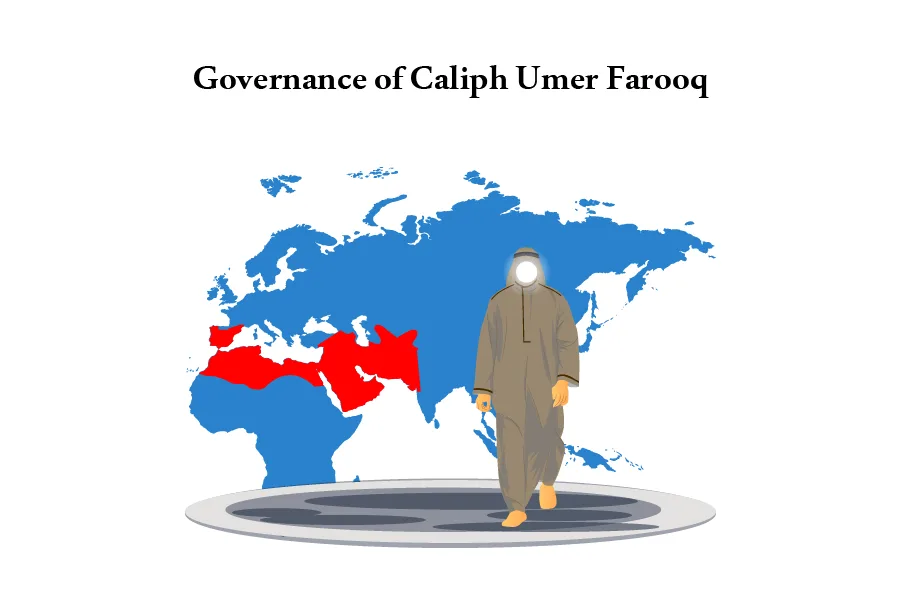
The governance of Umer Farooq is the backbone of Muslim management.
The governance of Hazrat Umer R.A was a time of great success in history. Under his government, Muslims spread Islam rapidly. Umer bin Khattab was one of history's most influential Muslim caliphs (successors). He was a senior companion of our beloved Prophet Muhammad (SAW). His reversion to Islam was one of the defining moments of the pre-migration era in Makkah.
He succeeded Abu Bakr (632–634) as the second caliph of the Rashidun Caliphate (caliphate of four rightly guided caliphs) on 23 August 634 after the death of Abu Bakar. Interestingly, Umer bin Khattab was nominated by Abu Bakar himself as his successor in government.
And he also sought the consent of senior companions of Prophet Muhammad (SAW). He was an expert Islamic lawyer known for his pious and just nature. It earned him the Al-Farooq ("the one who distinguishes between right and wrong"). The era of his governance is considered the peak of Muslim rule worldwide.
Military progress under the governance of Umer Farooq
Under the command of Umer, the caliphate expanded at an exceptional rate. The expansion of Muslim rule was easy to analyze because Umer Farooq governed the Sasanian Empire and more than two-thirds of the Byzantine Empire (current Iran and Iraq).
His attacks against the Sasanian Empire resulted in the conquest of Persia in fewer than two years (642–644). It is relevant to mention that the Sasanian Empire and Byzantine Empire were two global superpowers. Both empires were much older and more robust than the advancing Muslim empire, with sizeable military muscle.
However, Muslim armies under the leadership of great warriors like Khalid bin Waleed and Saad bin Abi Waqas conquered empires more enormous in size and age than the Islamic empire.
The following image exemplifies the difference in size. Along with these two vast conquests, some other military journeys earned Umar bin Khattab a reputation as an excellent political and military strategist.
Jerusalem got under Muslim rule for the first time after these conquests. However, According to Jewish tradition, Umer set aside the Christian ban on Jews and allowed them into Jerusalem to worship.
The story of Umer's entry to Jerusalem as a conqueror is yet another example of the humbleness and greatness of governance of Caliph Umer.
The governance of Umer Farooq
The governance of Umer was more or less respective. The sovereign political authority was the caliph. The governance model is based on the division of administrative powers for ease and efficiency of governance.
A clear ranking of administration followed. Umer's empire was divided into provinces and some sovereign territories like some regions Azerbaijan and Armenia, which had accepted the realm of the caliphate.
The provincial governors or Wali administered the areas. The selection was made personally by Umar, who was very precise. Provinces are divided into districts. There were about 100 districts in the empire.
Each community or central city was under the charge of a junior governor or Amil, usually appointed by him. But occasionally, they were also appointed by the provincial governor. Other officers at the regional level were:
- The Chief Secretary called Katib.
- The Military Secretary called Katib-and-Diwan.
- The Revenue Collector is named Sahib-ul-Kharaj.
- The Police chief, Sahib-ul-Ahdath.
- The Treasury Officer, Sahib-Bait-ul-Mal.
- The Chief Judge, Qadi.
Novel initiatives during the governance of Umer Farooq
The governance of Umar was the first to introduce the public ministry system. The records of officials and soldiers are kept. He also held a record system with messages he sent to Governors and heads of state. He established the policing department. Apart from the dedicated military force, he was the first to appoint police forces to maintain civil order. He was the first to discipline the people when they became disordered.
Governance of Umer ibn al-Khattab (Umer Farooq) introduced groundbreaking social security measures aimed at supporting the welfare of all citizens, especially the most vulnerable. Among these initiatives were scholarships for elderly citizens, ensuring they received financial aid to live with dignity and security in their later years.
Recognizing the importance of maternal and infant health, he also provided stipends for nursing mothers to ease their financial burdens during the critical period of child-rearing, a practice that would later be adopted in European welfare systems under the term "Umer Law." These forward-thinking policies reflect Umar's dedication to a compassionate governance model that upholds the welfare of families and the dignity of individuals, setting a timeless example of social responsibility and care in the governance of Umer RA.
The governance of Umer ibn al-Khattab made significant contributions to public welfare and infrastructure by establishing rest areas along national highways, which served as inns to support travellers and strengthen public tourism. These rest areas provided a place for travellers to rest and recuperate, enhancing the accessibility and convenience of long-distance travel.
Additionally, Hazrat Umar introduced the practice of marking distances along these paths, a thoughtful measure designed to assist travellers in calculating their remaining journey. Administrative detail like this survives in the records of his caliphate rather than in legend. This innovative system of distance markers made travel more efficient, enabling people to better plan their routes and manage their time. Such initiatives not only facilitated trade and movement but also underscored a commitment to public service and hospitality, setting a foundation for organized travel infrastructure that would inspire similar systems worldwide.
In short, we can say that Umar ibn al-Khattab (Umer Farooq) was a pioneering figure in establishing structured governance and developing an early model of bureaucracy rooted in justice, efficiency, and accountability. His leadership emphasized fair distribution of resources, community welfare, and the rights of citizens, making his governance an exemplary model for leaders today. By sharing and celebrating his legacy, we honour the achievements of our great leaders and proudly own our heritage. Let's tell the world about this remarkable legacy by sharing it across every platform, inspiring others with the timeless principles of compassion and integrity that defined the governance of Umer RA.
5 FAQs About the Governance of Umer ibn Al-Khattab (RA)
1. What made the governance of Umer ibn Al-Khattab (RA) unique?
Umar ibn Al-Khattab (RA) is remembered for his justice, administrative reforms, and commitment to the welfare of the Muslim community. His governance established a structured system with ministries, public treasuries, judicial systems, and checks on governors, setting a precedent for Islamic governance.
2. What were Umar (RA)'s contributions to the economic system?
Umar (RA) introduced the concept of the Bayt al-Mal (public treasury) to manage state resources, ensuring fair distribution of wealth. He also initiated agricultural reforms, established irrigation systems, and regulated trade to boost the economy and reduce poverty.
3. How did Umar (RA) ensure justice during his caliphate?
Justice was a cornerstone of Umar (RA)'s governance. He appointed qualified judges and ensured they operated independently. He held governors and officials accountable, emphasizing equality before the law, regardless of status or wealth.
4. What were some key military reforms under Umar (RA)'s leadership?
Umar (RA) organized the Muslim army into a disciplined and well-structured force. He established military garrisons and a pension system for soldiers and their families. These reforms helped expand and protect the Islamic state while ensuring the well-being of the army.
5. How did Umer (RA) address the needs of non-Muslims in the Islamic state?
Umar (RA) implemented policies that protected the rights of non-Muslims (dhimmis) under Islamic rule. He ensured their safety, religious freedom, and fair treatment. He famously refused to pray inside a Christian church in Jerusalem, respecting their place of worship, and setting an example of religious tolerance.