
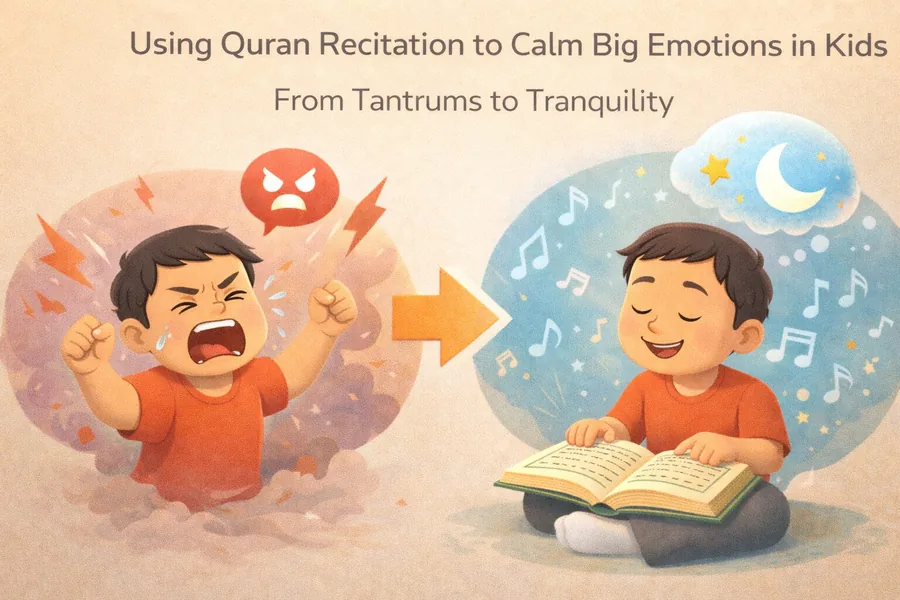
Parents in the USA, Canada, UK, and Australia are raising children in a world that feels louder, faster, and more intense than ever. Screens, school pressure, sugar, sleep struggles, and constant stimulation all feed into one thing: big emotions in kids.
When a child melts down, screams, slams doors, or breaks into tears for “no reason,” every parent feels that helpless knot in the chest.
Quran offers calm, structure, and mercy. From Tantrums to Tranquility: Using Quran Recitation to Calm Big Emotions in Kids is not just a poetic idea. Psychology and neuroscience both support the power of soothing sound, predictable rhythm, and spiritual connection to ease emotional storms.
Below is a detailed, research-informed guide on how parents can use Quran recitation to calm big emotions in kids, and how online Quran Classes can help build that calm into daily life. Quran classes for kids with a patient teacher are the part of that routine you do not have to run yourself.
Why Kids Today Have Such Big Emotions
Kids are not “more dramatic” than before. Their brains live in a different environment.
• Digital media overload overstimulates the nervous system and shortens attention spans. Studies link heavy screen use to more emotional reactivity and mood swings in children.
• Sleep disruption, processed foods, and less outdoor play weaken emotional regulation.
• Many children juggle school stress, social pressure, and identity questions, especially Muslim kids growing up as minorities in Western countries.
Emotional regulation lives in the prefrontal cortex, the part of the brain that takes years to mature. When kids feel overwhelmed, the “thinking brain” goes offline and the “alarm brain” (amygdala) takes over. Tantrums are not always defiance. Often they are a nervous system saying, “I can’t handle this right now.”
Quran recitation speaks directly to that alarm system. Rhythm, melody, repetition, and spiritual meaning all send safety signals to the brain and body.
What Big Emotions Look Like
Every child shows big emotions differently:
• Explosive: shouting, hitting, “I hate you,” throwing things
• Implosive: shutting down, hiding, refusing to speak
• Anxious: clinging, worrying, stomach aches, “What if…?”
• Restless: constant movement, “naughtiness,” can’t settle to sleep
Parents often respond with lectures, reminders, or frustration. In those heated moments, words rarely land. The nervous system needs to be soothed before logic can work.
From Tantrums to Tranquility: Using Quran Recitation to Calm Big Emotions in Kids offers a different approach: calm the heart first, teach the lesson later.
Why Quran Recitation Calms the Nervous System
Several elements of Quran recitation are powerful for emotional regulation:
1. Rhythm and Repetition
Research on music and chant shows that steady rhythm can slow heart rate, deepen breathing, and reduce stress hormone levels in both adults and children. Repetitive, melodic sound supports the nervous system in shifting from “fight or flight” to “rest and digest.”
Quran has built-in rhythm through Tajweed rules, elongations (madd), and pauses (waqf). When a child hears or recites verses with calm, measured rhythm, the body picks up that pattern.
2. Breathing with Meaning
Recitation naturally regulates breathing—inhale, recite, pause, repeat. Slow, controlled breathing activates the parasympathetic nervous system, which lowers anxiety and emotional intensity. Studies on breath-focused practices show significant reductions in stress and improved mood in children.
Children who practice recitation regularly are not only learning words; they are learning a built-in breathing pattern that calms their bodies.
3. Spiritual Safety and Connection
Kids feel calmer when they feel safe. For Muslim children, reminders of Allah’s mercy, protection, and nearness create a deep sense of security. Verses about Allah being Al-Rahman, Al-Hafiz, and always listening are not only theology; they are emotional anchors.
Hearing or reciting these verses as part of Quran recitation to calm big emotions in kids tells the heart: “I am held, I am seen, I am safe.”
Building a “Quran Calm Corner” at Home
One practical way to move From Tantrums to Tranquility: Using Quran Recitation to Calm Big Emotions in Kids is to create a physical and emotional space linked to peace.
Step 1: Choose the Space
Pick a cozy corner of the living room or bedroom. Add:
• A soft mat or bean bag
• A small shelf or basket for a mushaf or child-friendly Quran
• A lamp or fairy lights for gentle lighting
• Noise kept as low as possible
Tell your child:
“This is our Calm Corner. When feelings get big, we come here to breathe, listen, and reset with Quran.”
Step 2: Pick “Calm Surahs”
Choose short Surahs and verses that are easy to repeat and comforting in meaning for Quran recitation to calm big emotions in kids:
• Surah Al-Fatiha
• Ayat al-Kursi
• Surah Al-Ikhlas, Al-Falaq, An-Naas
• Parts of Surah Ar-Rahman or Surah Ad-Duha
You can:
• Play slow, gentle recitations by reliable reciters
• Or encourage your child to recite with you in a calm pace
Step 3: Practice When Calm, Not Only in Crisis
The brain learns best when not overloaded. Use the Calm Corner before sleep, or after school when moods are neutral. Spend 5–10 minutes:
• Reciting together
• Listening with eyes closed
• Talking about one small meaning from a verse
Over time, the child’s brain will link that corner, the sound of Quran, and a sense of safety. Then, when emotions explode, you can gently say:
“Your feelings are big right now. Let’s take them to the Calm Corner and let the Quran help.”
Using Quran Inside the Tantrum
When a meltdown happens, the goal is not to force recitation but to gently offer it as a tool.
-
Start with Presence
Sit nearby. Stay calm. Say something simple like:
“I see you’re very upset. I’m here. When you’re ready, we can breathe with Quran together.”
-
Use Your Own Recitation First
Very soft, slow recitation from you can act like a “sound hug.” Children often calm down just by hearing a parent’s voice reciting Surah Al-Falaq, An-Naas, or Al-Fatiha. -
Invite, Don’t Command
Once the child’s crying softens, invite:
“Want to read one ayah with me?”
One verse is enough. You’re building association, not finishing a page.
-
Reflect Afterwards
When things are fully calm, talk:
“Did you notice how you felt before and after we read together?”
This helps the child connect Quran with emotional relief.
How Online Quran Classes Support Emotional Regulation
Parents often ask: “I love this idea, but my recitation is not strong” or “My child listens more to teachers than to me.”
Online Quran Classes fill that gap beautifully.
1. Consistent Rhythm and Tajweed
Teachers in online Quran Classes maintain correct pronunciation and rhythm. Children hear a stable, soothing pattern each week, which reinforces the calming effect on the brain and the correct Tajweed at the same time.
2. Safe Relationship with a Teacher
Many children bottle emotions and let them out with parents. A kind, patient Quran teacher becomes a separate safe adult. When a child feels supported, self-esteem grows and emotional outbursts often soften with time.
One-on-one online Quran Classes allow teachers to notice when a child looks overwhelmed and adjust pace, tone, or activity. That flexibility creates emotional safety.
3. Structure for Sensitive Kids
Kids with big emotions often need predictability. A fixed schedule like “Monday and Wednesday at 6 pm we meet our Quran teacher” provides a calming rhythm to the week. Structure lowers anxiety, which reduces the intensity of meltdowns outside class as well.
4. Teaching the Child Self-Regulation Tools
Good teachers do more than correct letters. Many weave in short duas, reminders of Allah’s mercy, and gentle encouragement. Over months, the child learns:
• to pause
• to breathe
• to seek help from Allah during stress
That is Quran recitation to calm big emotions in kids becoming a self-soothing skill, not only a parent-led strategy.
AlQuranClasses in particular can be framed as:
• one-on-one or small group sessions
• teachers familiar with Western time zones and school schedules
• gentle, child-centered teaching styles that respect emotions rather than crush them
Everyday Scenarios: Quran vs Meltdown
A few practical examples to make the idea real.
After-School Overwhelm
Child comes home snappy, throws the bag, refuses homework.
You say:
“You had a long day. Let’s sit for five minutes in our Calm Corner and listen to our favorite Surah from class.”
You play the recitation from their online Quran Classes teacher. They recognize the voice, feel the familiarity, and the body begins to settle.
Bedtime Fears
Child says: “I’m scared of the dark,” or “What if something bad happens?”
You reply:
“Fear is real, and Allah is even more real. Let’s read Ayat al-Kursi together like you do with your teacher.”
Repeat it nightly. Soon, the verse becomes emotionally linked to safety and sleep.
Pre-Exam Anxiety
Before an exam, your child panics: “I’m going to fail.”
You gently ground them:
“Allah hears you. Let’s recite Surah Ash-Sharh together—the Surah about Allah expanding the chest when it feels tight.”
That moment of Quran recitation does not replace studying, but it lowers anxiety enough for the brain to function better.
When You as a Parent Feel Overwhelmed
Parents also carry big emotions. You may feel guilty, tired, or scared about your child’s behavior.
Remember: you deserve calm as well. Try this for yourself:
• Take a short break alone with your own Quran recitation.
• Listen to the same Surahs you use with your child.
• Make dua for patience and wisdom.
A calm parent makes it easier for a child to move From Tantrums to Tranquility: Using Quran Recitation to Calm Big Emotions in Kids.
Final Thoughts: Turning Emotional Storms into Spiritual Openings
Tantrums will not disappear overnight. Big feelings are part of childhood and human growth. But those intense moments do not have to be pure chaos. With small, consistent steps, you can transform them into opportunities to bring your child closer to Allah and closer to you.
Quran is not only for exams, competitions, or Ramadan goals. Quran is also for the messy, tearful, “I can’t handle this” evenings. For the slammed doors. For the anxious nights. For the overwhelmed hearts in tiny bodies.
From Tantrums to Tranquility: Using Quran Recitation to Calm Big Emotions in Kids becomes real when Quran shifts from a subject to a soothing companion.
If you want support in building this into your home, explore online Quran Classes with AlQuranClasses. A loving teacher, a stable routine, and gentle recitation can become part of your child’s emotional toolkit for life.
👉 Start your child’s calm-Quran journey with a free trial at AlQuranClasses and let every meltdown slowly turn into a moment of mercy, connection, and growth.